 Loading Please Wait...Loading Please Wait...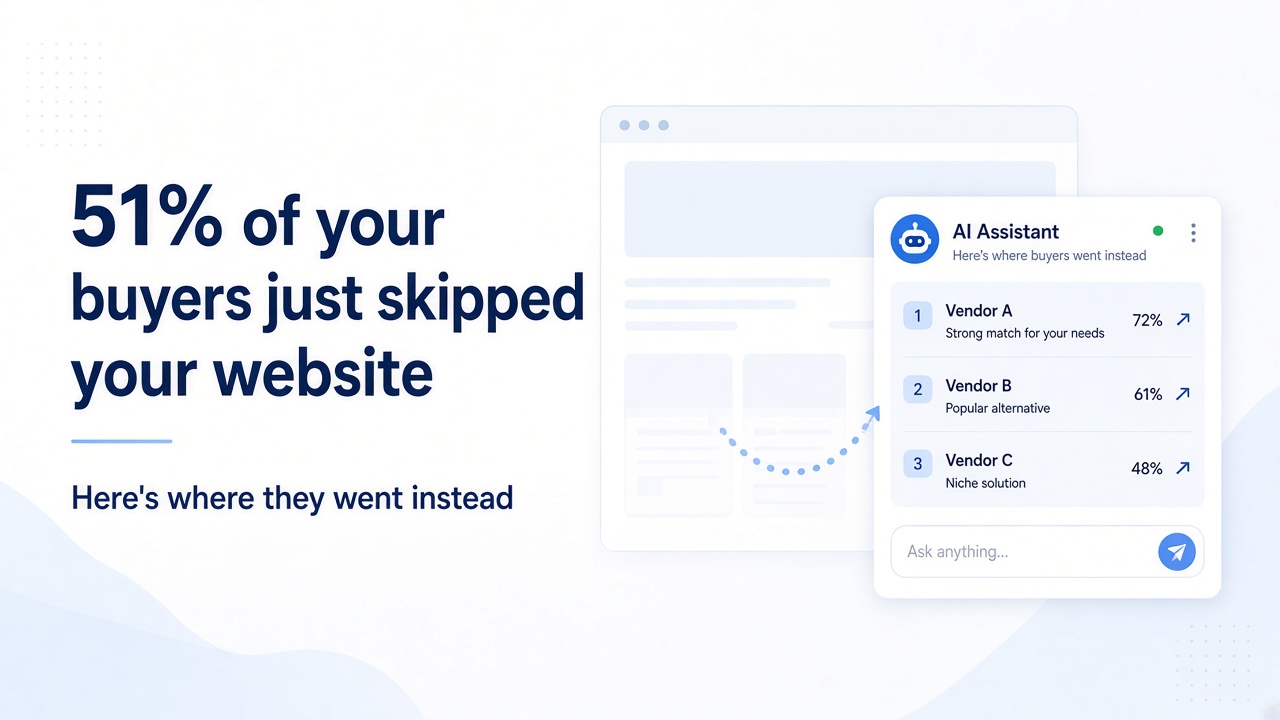
Picture your ideal customer right now. Real budget, real timeline, actively comparing options in your category. A year ago, you knew roughly where to find them — a Google search, a few tabs open, your website somewhere in that rotation. Today, there's a genuine chance they never opened a search engine at all. They opened ChatGPT, described their problem in a sentence, and got back a shortlist with two or three names on it.
That's not a hunch. G2's 2026 report, The Answer Economy: How AI Search Is Rewiring B2B Software Buying, found that 51% of B2B software buyers now start their research inside an AI chatbot more often than a search engine — up from 29% just a year earlier. A shift that used to take a decade to play out in marketing happened in twelve months, and it's still accelerating.
What makes this shift different, though, isn't just where buyers start. It's how much they hand over once they get there.
Buyers used to use search engines to build their own shortlist — read a few reviews, compare a few sites, form their own opinion. Now they're increasingly letting the AI form that opinion for them. The same G2 research found that AI chatbots have become the single biggest influence on which vendors make a buyer's shortlist, ahead of review sites and vendor websites both. And once an AI recommends someone, buyers largely go with it: 69% of buyers in that study ended up choosing a different vendor than the one they'd originally planned to, simply because of what the chatbot told them. A third bought from a company they'd never heard of before that conversation.
If your category comes up in a buyer's chat with an AI model and your company isn't part of the answer, you haven't lost a ranking position. You were never in the conversation to begin with — and the buyer will likely never know you existed as an option.
Here's the part that should actually worry you more than the stat itself: you'd have no way of knowing this is happening.
Your analytics can tell you about the visitor who came from a Google ad, filled out a form, and booked a demo. They can't tell you about the buyer who asked ChatGPT for the best tool in your category, got three names back, picked one, and never generated a single trackable event on your site — because there wasn't one to generate. That entire evaluation, including the moment a competitor got recommended in your place, happens in a space your dashboards were never built to see.
The natural next question is: why do some companies get recommended and others don't? It isn't luck, and it isn't simply brand size.
The research that effectively created this field — a study out of Princeton, Georgia Tech, and IIT Delhi — found that AI systems are measurably more likely to cite sources that include clear statistics, credible references, and direct, well-structured answers to specific questions. The same study found something almost counterintuitive: the keyword-heavy writing that used to help with search rankings actually performs worse in AI answers than doing nothing at all. The tactics that built visibility for the last twenty years and the tactics that build it now are not the same tactics.
Most current advice on this stops at content tactics — write more FAQs, add more citations, publish more stats. All useful, but underneath that is a harder question: before an AI model can cite you well, it has to be able to describe you accurately in the first place. And that depends on something most companies have never actually audited — whether their own website agrees with itself.
If your pricing page implies one thing, your product page describes it slightly differently, and a case study uses a third set of terms for the same offering, a human reader glosses over that. An AI model doesn't. It reads that as conflicting information, and it either guesses at which version is right or quietly leaves you out of the answer in favor of a competitor whose story is easier to piece together.
That's the real shape of the problem, and it's not a content problem so much as a data problem — the same kind of inconsistency that quietly corrupts marketing dashboards is now quietly deciding whether AI systems can recommend you at all.
Open ChatGPT or Perplexity and ask what it would recommend for your category. See what it says about you, if anything, and how confidently it says it. If you don't like the answer, or there isn't one, that's worth treating as seriously as a ranking drop would have been three years ago.
At DataQuark, the way we think about this follows the same discipline we apply to any data problem: Collect, Collate, Activate. The same data documentation and architecture work that gives a business a single, governed definition of its numbers — instead of five slightly different versions across five teams — is what gives it a single, consistent story to tell as well. When your data foundation is unified through practices like data documentation and a clean data architecture, the facts about your business stop living in five disconnected places and start coming from one place everyone, and eventually every AI system reading your content, can rely on.
That's a natural extension of the same work that builds a Single Consumer View or a governed data pipeline — the underlying discipline doesn't change, only where it shows up next.
If you're not sure what AI chatbots currently say about your company — or what they'd recommend instead of you — that's worth finding out before your competitors do. At DataQuark, we help organizations build the data foundation that keeps their brand accurate, consistent, and visible, to buyers and AI systems alike.
Talk to DataQuark about building the data foundation that keeps your brand accurate, consistent, and visible to buyers and AI systems alike.
Talk to usWhat would you love to learn how to do?