 Loading Please Wait...Loading Please Wait...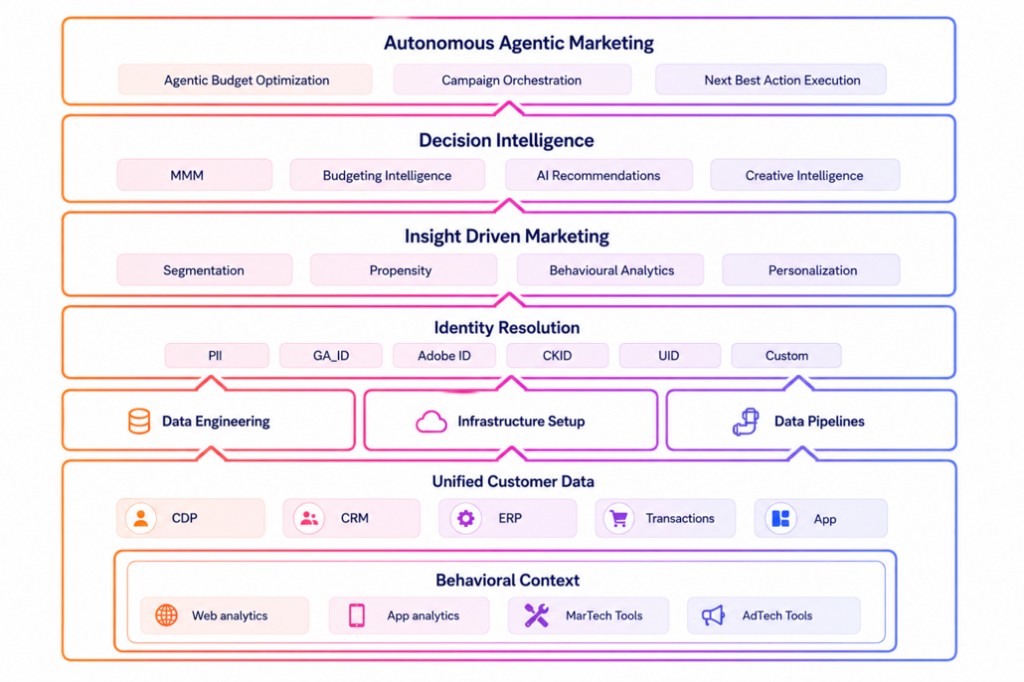
From Behavioural Signals to Autonomous Agents — How DataQuark's layered Marketing Data Architecture turns fragmented data into agentic marketing capability.
Modern marketing no longer fails because of a shortage of data. It fails because the data remains trapped in disconnected layers — analytics platforms talking only to themselves, CRM systems holding incomplete customer views, media platforms optimizing in isolation, and AI experiments running on ungoverned foundations.
The architecture below is DataQuark's response to that reality. It is a deliberately sequenced stack that moves organisations from raw behavioural context all the way to autonomous agentic marketing — while embedding the governance and identity discipline required for trust and scale.
Everything begins at the bottom with two complementary layers.
Captures the high-velocity signals of how customers interact with the brand. Data sources include: Web analytics, App analytics, MarTech tools, AdTech tools. These sources generate the continuous stream of events, clicks, views, scrolls, form fills, and engagement signals that reveal intent and journey progression.
The systems of record that hold durable customer and business context: CDPs, CRMs, ERP, Transactions, App data. When these two layers remain separate, brands see only partial journeys. When they are deliberately connected, a far richer picture emerges.
Raw signals and customer records become useful only when they are reliably collected, transformed, and made available. This is the role of the central technical layer.
This is where metadata, lineage, quality frameworks, and access controls are operationalised. Without this layer, identity resolution and advanced analytics rest on sand.
Identity Resolution is the hinge of the entire architecture. It is where fragmented identifiers — PII, GA_ID, Adobe ID, CKID, UID, and custom keys — are resolved into coherent customer profiles.
This is not a technical afterthought. It is the prerequisite for every higher-value capability. Accurate identity resolution enables:
It is also the foundation that future agents will depend on when they need to know who they are acting for and why.
With unified, identity-resolved data in place, brands can move from descriptive reporting to genuine insight.
This is the layer most organisations aspire to, yet few reach consistently — because the underlying identity and governance work was incomplete.
Insight becomes commercially powerful when it informs resource allocation and creative decisions.
Here the system begins to recommend where to spend, how to allocate, and what messages or experiences are likely to perform. Human marketers still make the final call, but they do so with far higher confidence and speed.
At the top of the stack sits the emerging capability that separates future-ready brands from the rest.
These are not science-fiction capabilities. They are the logical outcome of a properly governed, identity-resolved, continuously refreshed data foundation. Agents can only act safely and effectively when the context they retrieve is accurate, consented, current, and lineage tracked.
The architecture is deliberately progressive by design. Each layer enables the one above it. Skipping identity resolution or governance in pursuit of quick AI wins almost always produces brittle results. Building the stack deliberately produces compounding returns — first in measurement confidence and efficiency, later in autonomous execution.
Brands that treat data infrastructure as a series of disconnected projects remain stuck in insight-driven marketing at best. Brands that treat it as a coherent, governed stack create the conditions for Decision Intelligence and, ultimately, Autonomous Agentic Marketing.
The same foundation that eliminated days of weekly reconciliation and delivered double-digit marketing efficiency gains in our earlier case study is the same foundation that can later support agentic budget optimisation and next-best-action engines.
Talk to us at DataQuark — we've helped brands at every stage of this journey, from laying the first data pipeline to deploying decision intelligence at scale.
Talk to usWhat would you love to learn how to do?