 Loading Please Wait...Loading Please Wait...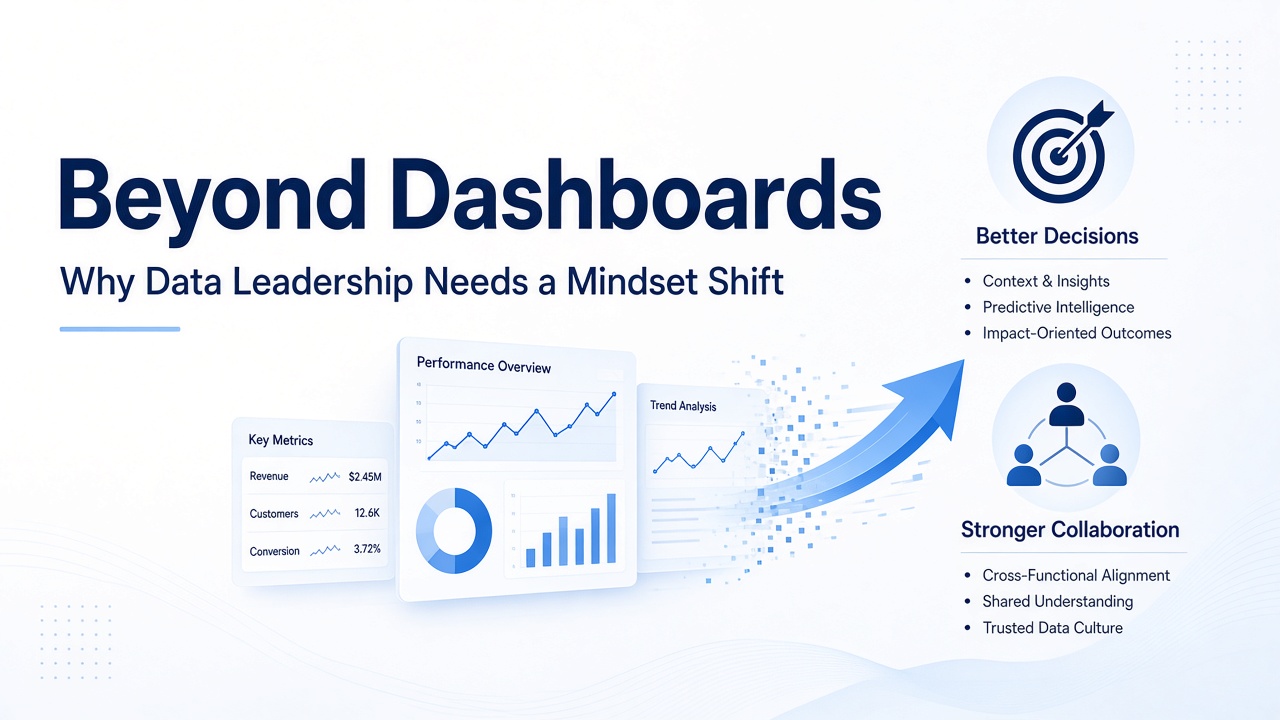
In most organizations today, data is everywhere — dashboards, reports, alerts, and real-time tracking. Every team has access to more numbers than they know what to do with. Yet, one challenge continues to persist across industries: we have more data than ever, but not enough decisions driven by it.
From a managerial lens, I've observed that this gap is not due to a lack of tools or tracking. Platforms like Google Analytics 4, advanced dashboards, and real-time reporting systems have made data collection easier than it has ever been. The real gap lies elsewhere — in how teams approach data itself.
Having worked across industries and teams, I believe the difference between organizations that thrive on data and those that drown in it comes down to three fundamental mindset shifts.
Data teams often focus on answering “what happened.” Reports are built, dashboards are refreshed, and metrics are tracked diligently. But business teams don't just need to know what happened — they need clarity on what to do next.
This is where most data initiatives fall short. A report that simply states “traffic dropped by 12% last month” has limited value on its own. The real value of analytics lies in connecting that insight to an action: why did it drop, what does it mean for the business, and what should the team do differently going forward.
When data teams shift their focus from reporting to decision enablement, they stop being a support function and start becoming a strategic partner in the business. The question changes from “what does the data show” to “what should we do because of what the data shows.”
There's a common assumption that more metrics lead to better understanding. In practice, the opposite is often true. Too many KPIs dilute focus rather than sharpen it. When every team is tracking twenty different numbers, it becomes difficult to know which ones actually matter.
The goal isn't to measure everything — it's to identify the few metrics that genuinely influence business outcomes and build clarity around them. A marketing team doesn't need fifteen engagement metrics if only two or three are actually tied to revenue or retention. Simplifying what gets measured often does more for decision-making than adding another dashboard ever could.
This shift requires discipline. It means having honest conversations about which metrics are “nice to know” versus which ones are “need to know” — and having the confidence to let go of the former.
Data cannot sit in silos, yet in many organizations, it still does. Marketing has its own dashboards, product has its own metrics, and analytics teams work in isolation, each optimizing for their own view of success rather than a shared outcome.
True impact happens when data becomes a shared language across teams — when marketing, product, tech, and analytics teams co-own outcomes rather than just their individual slice of the data. This doesn't mean everyone needs to be a data expert. It means everyone needs to be aligned on what success looks like and how it's measured, so that decisions made in one part of the business don't work against decisions made in another.
Collaboration around data also builds trust. When teams understand how a metric is calculated and why it matters, they're far more likely to act on it rather than question it.
In my experience working across industries, the organizations that succeed are not the ones with the most sophisticated tools — they're the ones that build a data-first culture with clear accountability and intent. Having access to GA4 or an advanced BI tool doesn't automatically make an organization data-driven. Culture does.
A data-first culture is one where:
Building this culture takes time, and it rarely happens through tools alone. It happens when leaders consistently ask “what does the data tell us” before making a call, and when teams are given the space to challenge decisions using evidence rather than opinion.
As managers, our role is not just to enable tracking — it's to ensure data translates into business impact. That means moving beyond the comfort of dashboards and reports, and actively pushing teams to ask sharper questions, focus on fewer but more meaningful metrics, and collaborate across functions rather than optimizing in isolation.
The tools will keep evolving. New platforms, better dashboards, more sophisticated tracking — all of that will continue to improve. But none of it matters if the mindset around data doesn't shift alongside it.
If any of this sounded familiar — dashboards full of numbers but a team still unsure what to do next — you're not alone. It's one of the most common gaps we come across.
At DataQuark, we've worked with plenty of teams who had the data and the tools, but weren't quite sure how to turn them into decisions.
Talk to usWhat would you love to learn how to do?