 Loading Please Wait...Loading Please Wait...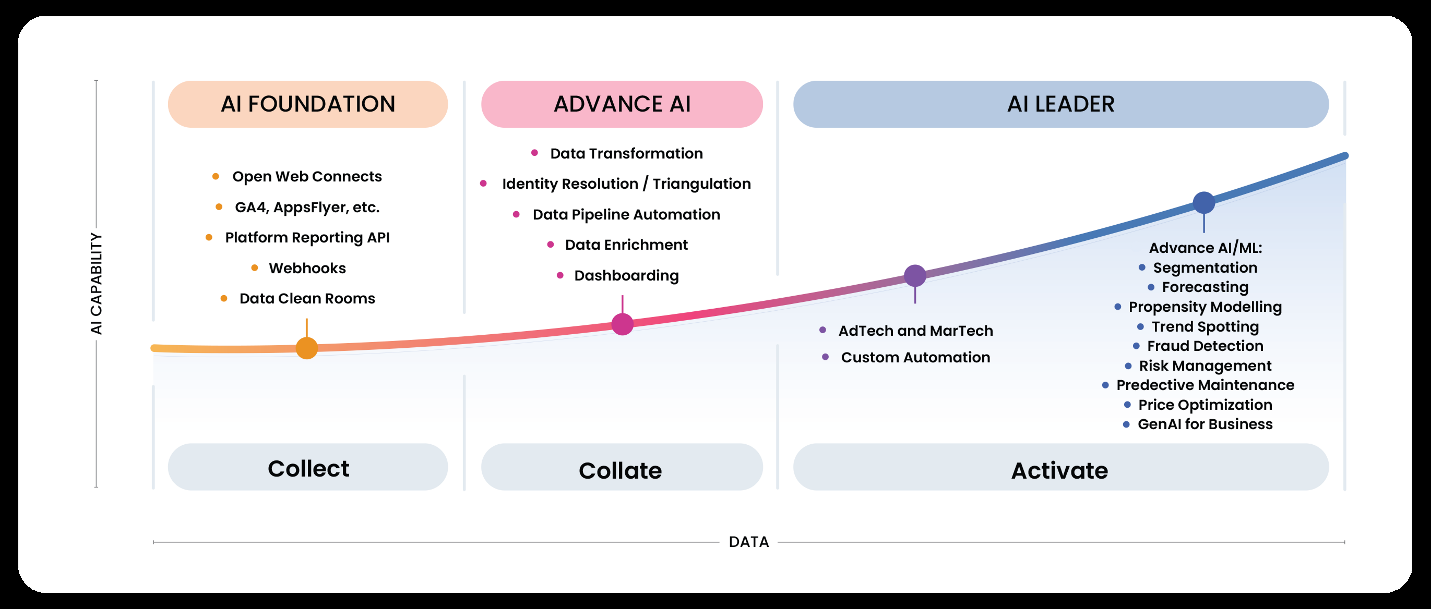
Every company claims to be data-driven. Very few can point to where, precisely, their data infrastructure sits on the path from raw information to competitive advantage. That gap — between the claim and the reality — is quietly costing organizations more than most balance sheets will ever show.
It shows up as marketing spend that can't be attributed with confidence. As AI pilots that were approved on the promise of “intelligent automation” and quietly shelved a year later because the underlying data couldn't support them. As board decks with numbers that get softly, silently caveated in the room: “directionally correct.”
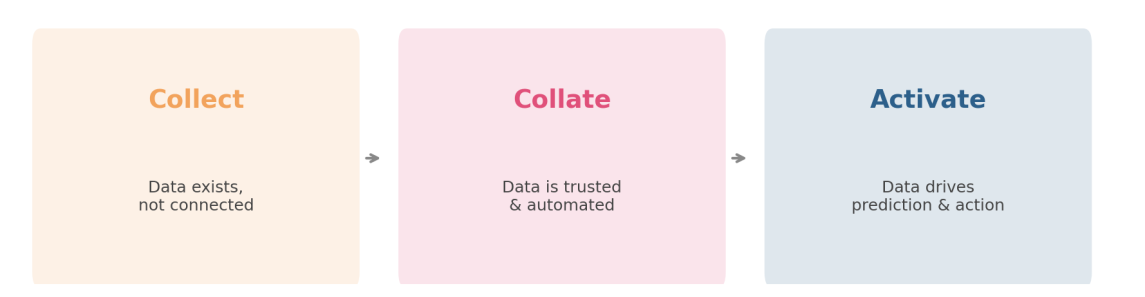
None of this is a talent problem. It's a maturity problem — and it has a shape. Three stages: Collect. Collate. Activate. Most organizations assume they're further along this path than they actually are, and that miscalibration is where the real cost hides.
At this stage, data exists. GA4 is tracking. AppsFlyer is capturing app activity. Ad platforms are reporting their own numbers. Webhooks fire, APIs pull. On paper, the organization looks instrumented.
In practice, none of it is connected. Every one of those sources tells its own version of the truth, and reconciling them is a manual, recurring tax on the team — hours spent assembling a report that should take minutes, and a boardroom number that carries a quiet asterisk nobody says out loud.
This is the foundation stage — necessary, but insufficient. Capital spent here buys visibility, not advantage. Organizations at this stage are, functionally, flying with instruments that don't talk to each other.
Decisions get made cautiously, defensively, and late — because leadership doesn't fully trust the number behind them, even when they act on it anyway.
This is the inflection point most organizations underestimate. Collation is where scattered signals become a coherent system: identity resolution stitches customer behavior together across channels, pipelines automate what used to be manual, data gets enriched and cleaned, and AdTech and MarTech platforms finally exchange information instead of operating as disconnected silos.
It's an unglamorous stage. Nobody presents “we improved our data pipeline automation” at a shareholder meeting. But it's the stage where data stops being raw material and becomes something the organization can actually build strategy on — reliably, repeatedly, without a manual audit every time a number gets used.
The strategic risk here is subtler: organizations at this stage often believe they've arrived. Dashboards are automated, reporting looks polished — but the team is still spending more time explaining discrepancies than acting on insight. Confidence outpaces capability.
This is where the return on data investment actually materializes. Segmentation, forecasting, propensity modelling, fraud detection, risk management, price optimization, and GenAI-driven decision-making — all of it depends entirely on the two stages beneath it being genuinely solid, not just assumed to be.
Very few organizations are honestly here. And the ones that attempt to skip to this stage — deploying AI and predictive tools on top of an uncollated data foundation — don't get intelligence. They get confidently wrong answers, delivered faster and at greater scale. This is precisely why a large share of enterprise AI initiatives quietly underperform or get shelved: the ambition was right, the foundation wasn't ready to support it.
Organizations that do reach this stage don't just report on what happened. They see what's about to happen, and they move first.
Most leadership teams place their organization a stage ahead of where it actually is — because instrumentation and automation look like maturity, even when trust and reliability haven't caught up.
A more honest gauge:
There is no penalty for being early on this curve. Most organizations are. The real exposure is strategic: committing capital and credibility to AI and automation initiatives before the data foundation beneath them can bear the weight.
The distance between these three stages isn't a technical nuance — it's a direct determinant of decision velocity and competitive positioning. Organizations further along this curve don't just report better. According to research from Heap, data-mature organizations have been shown to significantly outperform peers on revenue growth, profitability, and customer metrics — the gap compounds over time, not overnight.
Meanwhile, the cost of misjudging where the organization actually stands is rarely visible on a single quarter's numbers. It shows up as AI investments that underdeliver, marketing spend that can't prove its own return, and strategic decisions built on data leadership hasn't fully interrogated.
Advancing from Collect to Collate to Activate is not a matter of acquiring another point solution. It requires deliberate investment in the infrastructure layer — the pipelines, identity resolution, governance, and automation that let data move cleanly from collection through to activation, rather than stalling at “instrumented but disconnected.”
That is precisely the function of Marketing Data Infrastructure: the connective layer that determines whether an organization's data remains a cost center to maintain, or becomes the asset that its next strategic advantage is built on.
Most leadership teams have a working assumption about where their organization sits on this curve. Few have tested it. At DataQuark, we help organizations move past the assumption — mapping exactly where they stand today, and what it takes to reach Activate.
Find out where your organization truly stands on Collect, Collate, and Activate — and what it takes to move forward.
Talk to usWhat would you love to learn how to do?