 Loading Please Wait...Loading Please Wait...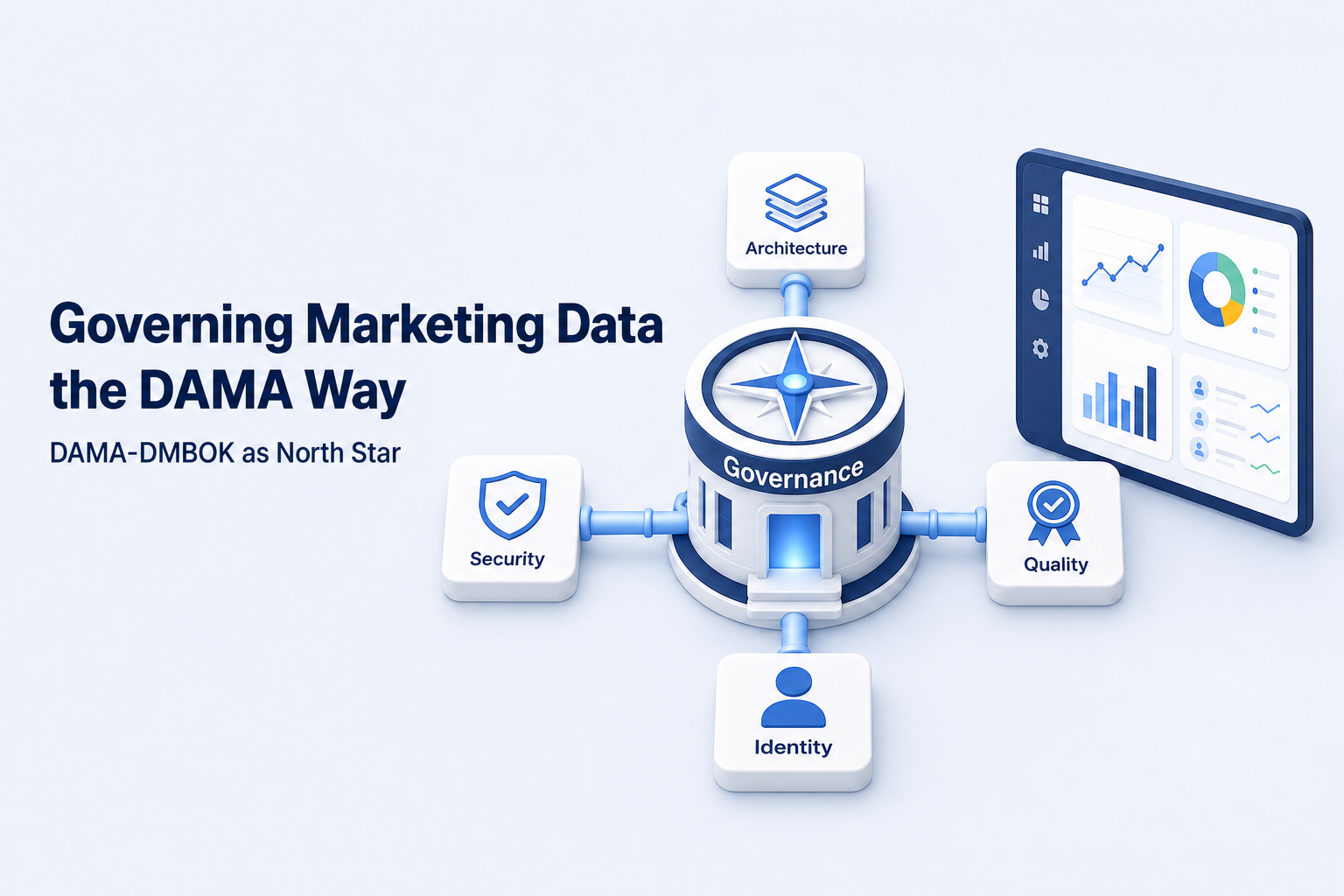
How DataQuark turns the Data Management Body of Knowledge into a practical operating system for modern brands.
Most marketing organizations today sit on more data than ever — Google Ads, DV360, Meta, CRM records, website and app events, offline conversions — yet still struggle with fragmented views, contested metrics, and limited readiness for advanced analytics or AI. The problem is rarely a lack of tools. It is the absence of coherent data management discipline.
At DataQuark we use the DAMA-DMBOK framework as our North Star for Marketing Data Infrastructure. DAMA provides the shared language and structure that turns scattered marketing signals into governed, trusted, and future-ready assets. This post explains how we operationalize that framework — and why it matters for brands preparing for agentic systems.
DAMA-DMBOK organizes data management into eleven interconnected knowledge areas, with Data Governance at the center. For marketing teams this is especially powerful because the data is inherently multi-source, high-velocity, and business-critical:
Without a structured approach, teams end up with competing “sources of truth,” manual reconciliation, and models that cannot be trusted. DAMA gives us the vocabulary and discipline to fix this systematically.
We translate DAMA’s strategic planning deliverables into concrete, marketing-specific outcomes:
We run joint business + technology discovery sessions. Marketing, analytics, product, and engineering teams sit together to surface use cases, critical success metrics, risks, and the preferred data-gathering model. The result is a shared charter that anchors every subsequent decision.
Clear goals and objectives are defined up front — what “source of truth” means for campaign performance, customer journeys, and revenue attribution.
We produce a phased plan (60-day, 90-day, 1-year, 3-year) that prioritizes marketing, outreach, analytical, and business use cases. Stakeholders and roles are explicitly assigned so accountability is never ambiguous.
Critical data sources and views (customer, campaign, channel, product, etc.) are identified. Mapping logic, identity resolution approach, and early opportunities for agentic journeys are documented. Delivery milestones are set against real business calendars.
This is not abstract governance theater. It is the practical scaffolding that makes Collect → Collate → Activate reliable and scalable.
Website and app user-journey events tracked in GA4 are a perfect illustration of how we apply the framework.
Technical drivers on the left. Business drivers on the right. Governance in every layer.
Definition: Website and app user-journey events are tracked using Google Analytics 4. The events contain data about user visit, pages visited, time on page, and click / form fill / view / scroll events on the webpage and more.
Salesforce [GAID], Ads, DV360, Meta
APIs, BigQuery connectors
Discovery document, Analytics Hub, QuarkAssist, Conversational API
Planning
Journey definition, event definition, reporting metrics
Development
Event setup, MMP setup, GAID capture, BigQuery setup
Control
GAID retention window
Operational
Event purge from BigQuery, tag hygiene check
CTO, Digital Analytics Head, CMO, DataQuark project team
Marketers / agencies: conversion rate, ROI
By treating GA4 events through the full DAMA lifecycle — rather than as isolated tracking — we create assets that can be trusted for attribution today and safely consumed by agents tomorrow.
Clean identity resolution, documented event definitions, lineage, quality rules, and access controls are exactly the capabilities future marketing agents will require. When an autonomous system needs to decide the next best action, personalize an experience, or reallocate budget, it must operate on context that is accurate, consented, and current.
The same DAMA-aligned foundation that eliminates manual reconciliation and conflicting dashboards also becomes the substrate for agentic journeys. Governance stops being a brake and becomes an accelerator.
We combine deep digital-marketing domain knowledge (Google Ads, DV360, Meta, MarTech, CRM, analytics platforms) with rigorous data-management practice. The result is Marketing Data Infrastructure that is:
The journey from fragmented marketing data to intelligent, agent-ready enterprises.
If your current data landscape still feels like a collection of silos rather than a governed operating system, the next conversation should be about building the foundation properly — starting with a clear charter, scoped roadmap, and DAMA-aligned implementation plan.
Let’s talk. At DataQuark we help brands operationalize DAMA for Marketing Data Infrastructure — from the first charter through agent-ready activation.
Talk to usWhat would you love to learn how to do?