 Loading Please Wait...Loading Please Wait...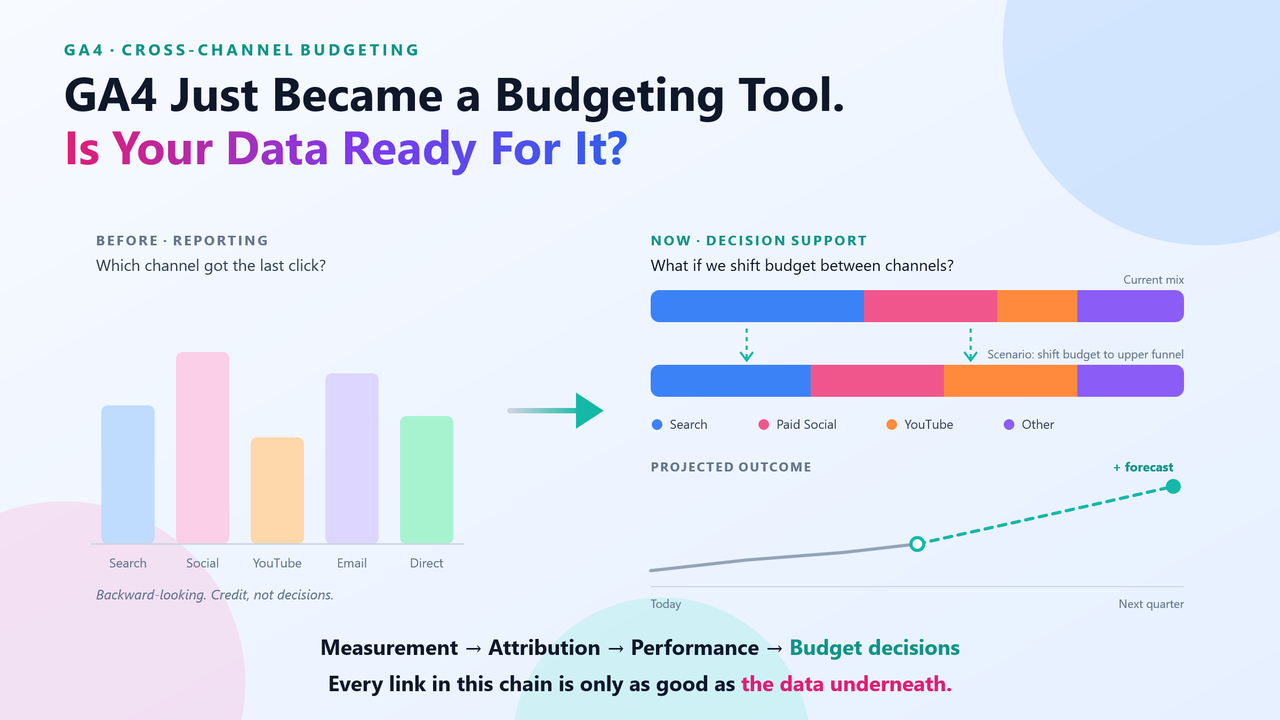
Google Analytics is quietly shifting from "tell me what happened" to "tell me where to invest next." That's a genuinely useful capability, but only for teams whose underlying measurement data can support a budget decision. Most can't yet.
Here's what changed, why it matters, and the four-question audit to run before you trust it.
For most of GA4's life, marketing analytics has answered a backward-looking question: what happened? Which channels drove conversions. Which campaigns generated revenue. Where customers came from.
That's no longer the hard part. The harder, more valuable question is forward-looking: where should we invest next?
Google's new cross-channel budgeting capabilities are a direct answer to that shift, connecting performance data to budget planning so marketers can model how different allocations might change outcomes, inside the same tool they already use to measure results.
In short: analytics is moving from a reporting layer to a decision-support layer.
Every marketing team already argues about questions like these:
Take a typical journey: Paid Social → YouTube → Organic Search → Brand Search → Conversion.
Judge it on last click alone, and Brand Search looks like the hero. But Paid Social and YouTube may have done the work of creating the awareness and consideration that made Brand Search convert at all.
Cross-channel budgeting reframes the question; from "which channel gets the credit?" to "how are our channels working together to drive the outcome?" That's a materially better question to be basing spend decisions on.
Here's the part that doesn't make it into most of the release notes: cross-channel budgeting doesn't reduce the need for a strong measurement foundation; it raises the stakes on it. A budgeting tool built on bad inputs doesn't give you a worse report. It gives you a confidently wrong instruction to move real money.
Before letting this influence a single budget decision, check four things:
| Question | What breaks if the answer is no |
|---|---|
| Are conversions measured correctly? | The model optimizes toward the wrong outcome; a form-fill treated as a qualified lead, or revenue that isn't actually captured. |
| Is channel data classified consistently? | The same campaign showing up differently across platforms makes the "cross-channel" view impossible to interpret. |
| Is revenue/value data reliable? | 1,000 low-value conversions can look better than 300 high-value ones if value isn't captured accurately. |
| Can you detect changes to your measurement setup? | Site releases, GTM edits, new campaigns, and consent changes silently corrupt the data budgeting decisions rely on — without ongoing QA, you won't know until the numbers are already wrong. |
You don't need to overhaul your entire media-planning process to benefit from this. You need to know whether your foundation can support it. Run through this checklist first:
If you can answer "yes" with confidence, the new capabilities become genuinely powerful. If you can't yet, that's the actual starting point, not the budgeting dashboard.
The value here was never the report itself. It's the chain behind it:
Measurement → Attribution → Performance → Budget decisions
For marketing leaders, that means using analytics not just to understand where the business has been, but to make more confident calls on where investment should go next; and that confidence has to start with the data underneath it, not the dashboard on top of it.
At DataQuark, we help organizations build and validate exactly that foundation; across GA4/GA360, Adobe Analytics, GTM and the wider martech stack; from implementation and governance through to ongoing data quality and channel performance analysis.
Book a measurement audit and we'll tell you exactly where your setup stands against the four questions above.
Book a measurement auditWhat would you love to learn how to do?