 Loading Please Wait...Loading Please Wait...
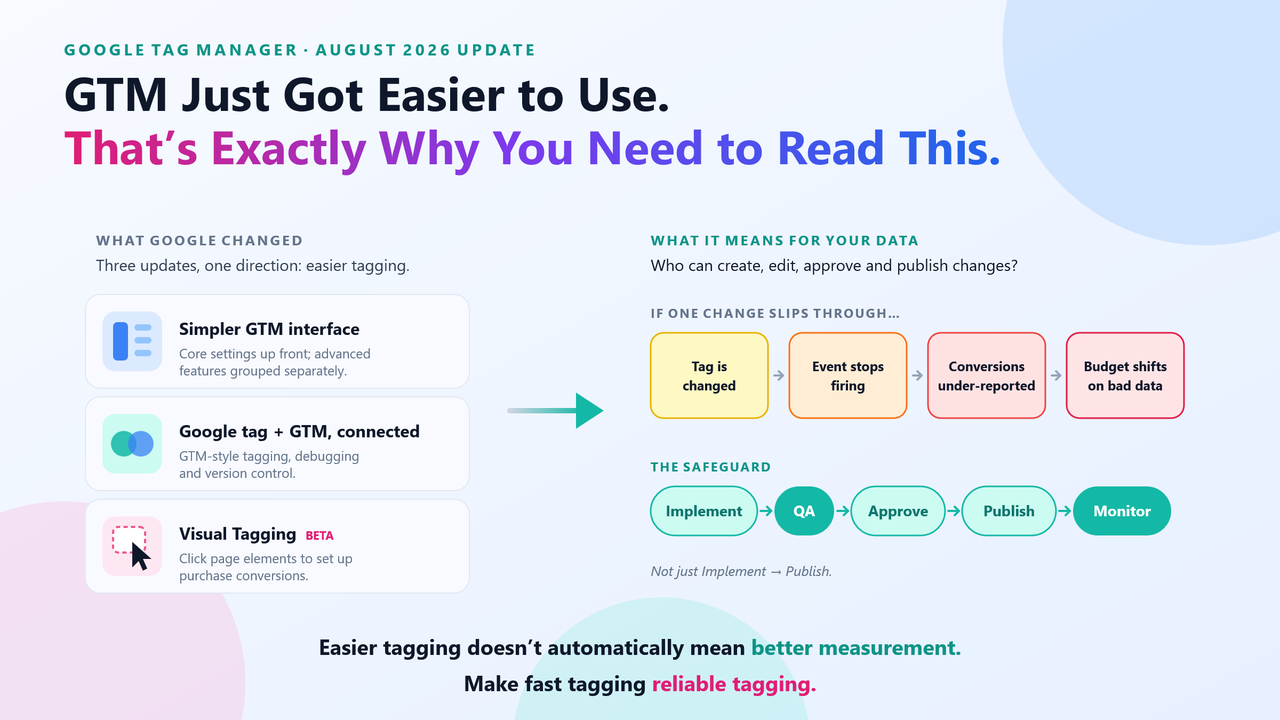
Google Tag Manager's August 2026 update — a redesigned interface, tighter integration with Google tags, and a new point-and-click Visual Tagging tool — makes measurement setup faster and more accessible to non-technical teams. That's genuinely useful. It also raises a governance question worth asking before you lean on it. Here's what changed, what it means, and the four things worth reviewing.
Google's latest updates pull the tagging experience closer together in three ways:
The Overview page is redesigned so core settings sit up front, while advanced features — triggers, variables, templates, folders — are tucked into a separate section. The goal: make it easier to see what's actually configured.
Sites running Google tag directly now get GTM-style features — interface-driven tagging, debugging, version control. Existing GTM users get an optimization flow that folds Google tag settings into the new structure and routes data straight to Google destinations.
Instead of manually defining selectors and triggers, teams can now click elements directly on the page and configure measurement through a guided flow. It's currently in beta for Google Ads purchase conversions, with more use cases expected to follow — and it will meaningfully lower the technical bar for setting up conversions.
Making measurement easier to implement is a real improvement. It also changes who's able to make the changes.
When tagging required technical fluency, edits were naturally concentrated among developers, analysts, or a specialist implementation team. As tagging becomes more interface-driven, organisations should pay greater attention to who can create, modify, approve and publish measurement changes — a governance question Google's announcement doesn't address, but one it makes more urgent.
Who's responsible for making sure every change still produces reliable data?
A tagging change that looks small can carry outsized weight:
A tag is changed → an event stops firing → conversions are underreported → campaigns look weaker than they are → budget gets reallocated based on incomplete data.
The tag was never really the problem. The chain of business decisions sitting on top of it is.
Marketers want faster implementation, less dependency on developers, quicker conversion setup, and more visibility into tagging. Organizations still need consistent naming, controlled access, version management, QA before publishing, consent-aware measurement, and monitoring after launch.
Those aren't opposing goals — they just need a process that holds both. The target isn't slower tagging. It's tagging that's fast and reliable.
| Area | What to check | What happens if you skip it |
|---|---|---|
| Tagging architecture | Do you have a clear structure across Google tags, analytics events, ad tags, custom tags, variables/triggers, and multiple destinations? | A cleaner interface can't compensate for a messy underlying setup — it just makes the mess easier to add to. |
| Governance & access | Who can create, edit, approve, and publish tags? | As tagging gets easier, unclear permissions turn into untracked changes fast. |
| QA & monitoring | Is each event firing at the right time, with the right parameters, reaching the right destination — without creating duplicate conversions? | A tag "working" in GTM doesn't mean the right data landed anywhere useful. Google's own visual-tagging flow checks for existing purchase conversions for exactly this reason — to avoid double-counting. |
| Change management | Do releases, campaigns, consent updates, and GTM edits all run through Implement → QA → Approve → Publish → Monitor — not just Implement → Publish? | Measurement quietly degrades every time a change skips the last two steps. |
GTM's evolution will lower the effort required for a lot of tagging work. It won't automatically improve the quality of what that tagging produces — and the value of any tagging platform still comes down to one thing: can you trust the data when it's time to make a decision on it?
That makes GTM less of a pure implementation tool and more of a piece of your measurement governance framework — worth treating that way even when the interface makes it feel simpler than it is.
The next phase of tagging isn't about adding tags faster. It's about building a measurement environment where teams can move fast without compromising what that data means.
As Google brings tagging, configuration, debugging and visual setup closer together, this is the moment to check whether your architecture, governance and QA can hold up in a more decentralized tagging environment — because the real question was never "can we implement this tracking?" It's:
Easier tagging doesn't automatically mean better measurement. Make fast tagging reliable tagging.
Talk to DataQuark about your GTM and measurement setup.
Talk to usWhat would you love to learn how to do?