 Loading Please Wait...Loading Please Wait...
Marketing technology has spent the last two decades helping organizations collect, connect, analyze and activate data. The next decade will be different.
The question used to be: "Which MarTech platform should we buy?" It's becoming: "How intelligently can our organization sense, decide and act?"
That shift could define the next generation of enterprise leaders. Multiple industry estimates now put the global MarTech market well past $500 billion, with most forecasts projecting it to more than quadruple by the early 2030s. At the same time, Gartner predicts 60% of brands will use agentic AI for one-to-one customer interactions by 2028. The next decade of MarTech won't just be about adding more tools — it will be about fundamentally changing how marketing works.
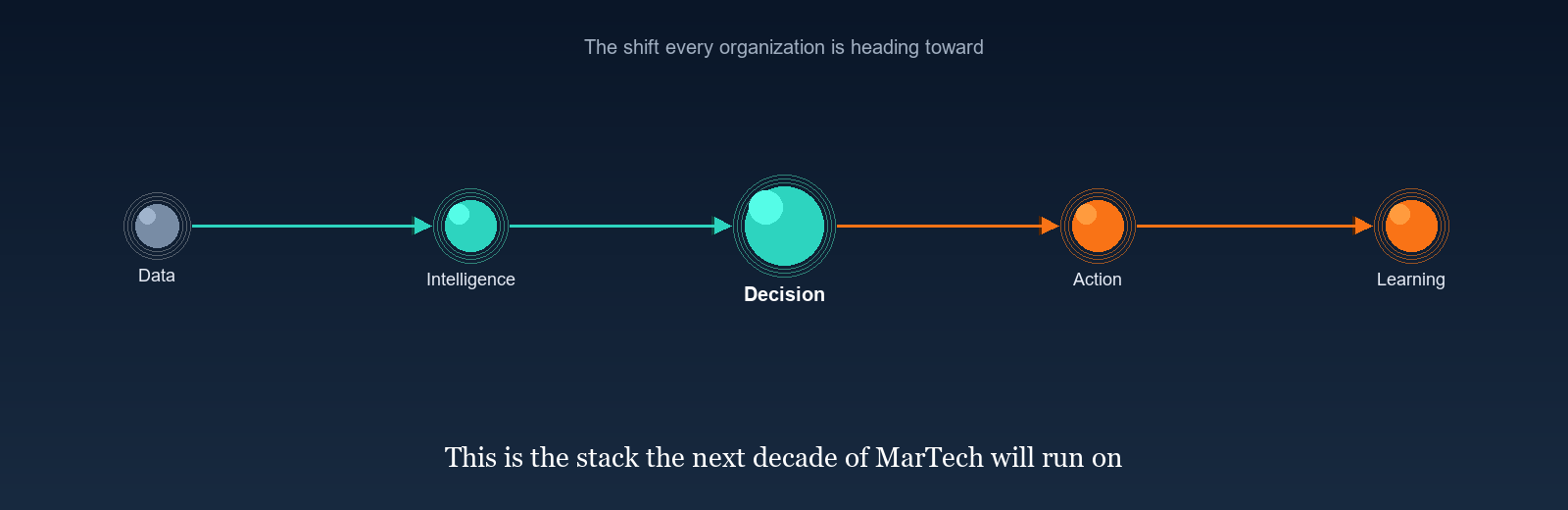
Enterprise marketing architecture has long looked like: CRM → CDP → Analytics → Campaign Management → Ad Platforms → Reporting. But customers don't experience companies through systems — they experience them through journeys.
The Intelligence Stack: six stages, one continuous loop
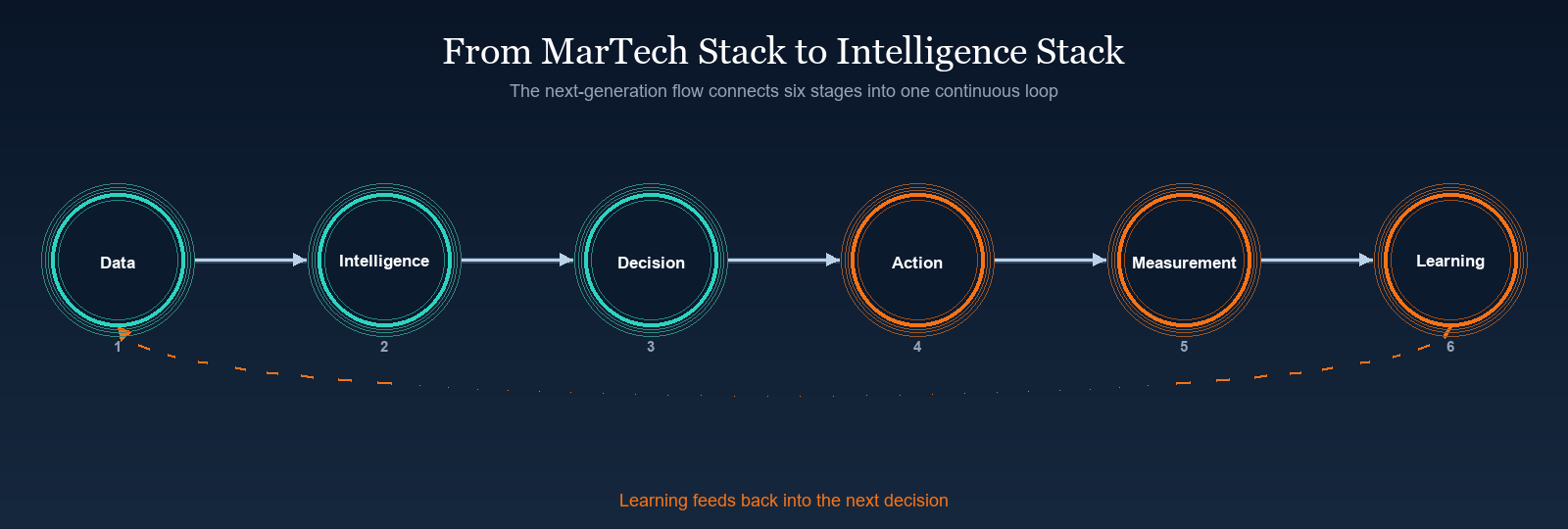
The next-generation stack connects: Data → Intelligence → Decision → Action → Measurement → Learning. Instead of marketers manually moving data between systems, AI agents will increasingly interpret signals, decide the next action, and execute across platforms. The MarTech stack may become less visible — intelligence will sit between the customer signal and the business action.
For years, organizations competed on how much data they collected. The next decade rewards a different question: how useful is our data for making decisions?
Not all data is equal. First-party, zero-party, behavioral, intent, and journey data will matter more than raw volume. A fragmented customer record tells you what happened across systems. A unified one tells you what's happening now — and what could happen next. That's the shift from data to customer intelligence.
Two organizations with similar budgets, products and tools can still have very different outcomes — because they don't have the same decision velocity. One takes days to spot a behavior shift and launch a response. Another detects it in real time and acts immediately.
The Decision Velocity Flywheel
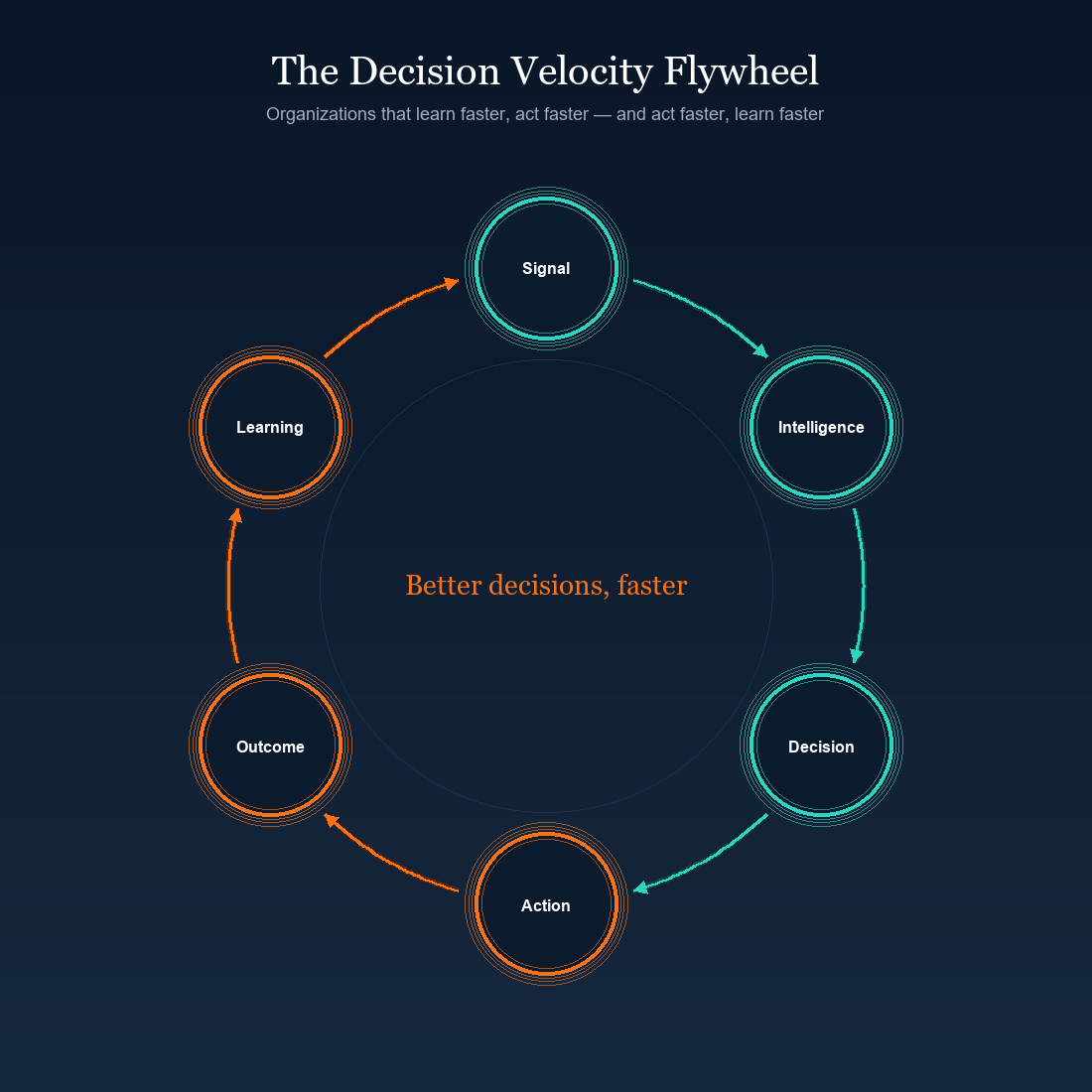
This creates a new flywheel: Signal → Intelligence → Decision → Action → Outcome → Learning → Better Decision. The organization that learns faster acts faster — and the one that acts faster learns faster.
The future of marketing isn't just humans using AI tools — it's humans working alongside AI assistants, specialized agents, and governance systems. A Customer Intelligence Agent could flag a behavior shift; a Propensity Agent could identify who's likely to respond; a Creative Agent could generate variants; a Governance Agent could check policy compliance. The human doesn't disappear — the role changes.
Routine execution is increasingly automatable. Human value shifts toward strategy, brand, ethics, relationship management, judgment, and governance. The real question isn't "will AI replace people" — it's "which work should humans own, which should AI augment, and which should agents execute?" That answer will differ by industry and risk profile, but the direction is consistent.
The bigger risk for most organizations isn't sudden obsolescence — it's slow economic erosion. Fragmented data, manual decisions, retrospective reporting, and disconnected journeys create a widening gap over time in speed, cost, personalization, and decision quality versus competitors who've unified their data and automated their workflows. This is why AI transformation is an operating-model question, not an IT project.
Gartner estimates up to $234 billion in enterprise application software spending could be exposed to agentic AI by 2030, as agents increasingly execute tasks directly rather than requiring humans to work through every interface. The future employee may not open ten platforms to complete one workflow — they may simply ask an agent to find the issue, recommend the action, and execute it.
It won't be the biggest database, the biggest AI model, or the biggest MarTech stack. It will be an organization's ability to combine data, context, intelligence, action, and learning into a compounding intelligence loop — where every outcome makes the next decision smarter.
The real question of the next decade isn't "are we using AI" — almost everyone will be. It's: can our data support AI? Can our technology let AI act? Can our people work effectively alongside AI agents? And ultimately — can we learn and act faster than the market around us?
The winners of the next decade won't have the most technology. They'll have the strongest connection between data, intelligence, decision, action, and learning.
That may be the question worth answering before investing in the next piece of technology.
At DataQuark, we work with organizations navigating exactly this shift — helping them turn scattered data and disconnected tools into the kind of connected intelligence this next decade will demand.
Talk to usWhat would you love to learn how to do?