 Loading Please Wait...Loading Please Wait...
Your campaign manager pulls up the dashboard on a Monday morning and reports a healthy conversion number. What that dashboard doesn't show is that Google and Meta's own systems — the ones actually deciding who to show your ads to — never saw a meaningful chunk of those conversions in the first place. They're optimizing campaigns with a partial picture, and nobody in the room knows exactly how partial.
This is the Pixel Problem, and it's quietly reshaping performance marketing whether your team has named it yet or not.
For years, tracking pixels — small snippets of code sitting in a browser — were how ad platforms knew a conversion happened. Someone clicked an ad, landed on a page, made a purchase, and the pixel fired, closing the loop.
That loop is breaking down. Privacy regulations, iOS tracking changes, third-party cookie deprecation, and ad blockers have all chipped away at what a browser-based pixel can actually see. The pixel isn't broken in the sense of malfunctioning — it's simply blind to more and more of what's actually happening.
The gaps aren't limited to browsers. Signal loss shows up everywhere a customer's journey crosses a boundary a pixel can't follow:
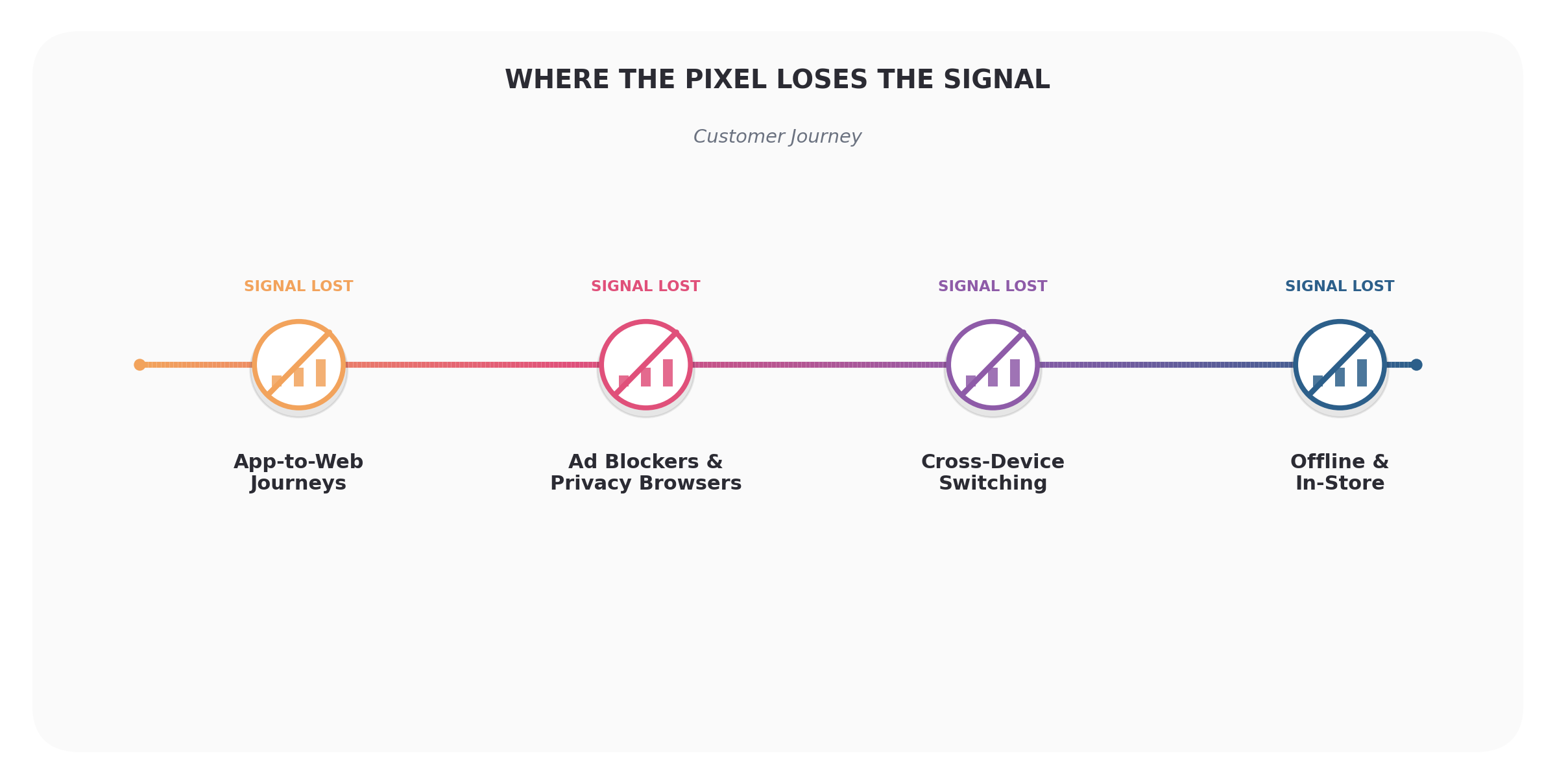
Individually, each gap looks minor. Together, they add up to a meaningful share of your real customer activity that your ad platforms simply never learn about.
Here's the part most teams underestimate: this isn't just a measurement inconvenience. It actively degrades how your ad platforms perform.
Google and Meta's targeting algorithms are machine learning systems — they get better at finding your next customer by learning from the conversions they can see. When a meaningful share of real conversions never reach the platform, the algorithm isn't just missing some reporting data. It's training on an incomplete, skewed sample of your actual customers, and optimizing toward the wrong signal as a result. Your targeting doesn't just look less accurate on a dashboard — it quietly becomes less accurate at finding people who convert.
This isn't an abstract inefficiency. Brands that have closed this signal gap have seen concrete, measurable swings in performance: 25–30% lower customer acquisition costs, a 10–28% increase in attributed conversions, and a 2x–3x uplift in return on ad spend, driven largely by cleaner data feeding faster, more accurate AI learning cycles on the platform side.
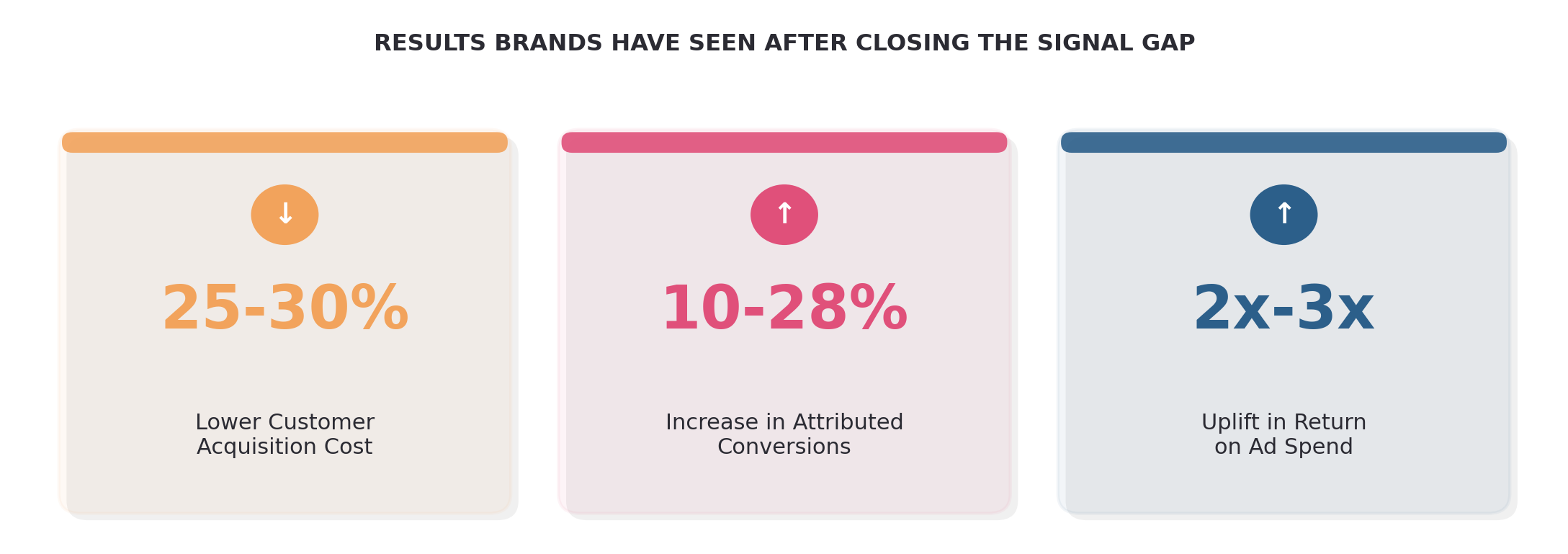
Read that in reverse, and it's a fair estimate of what incomplete signal is quietly costing brands that haven't fixed it — inflated acquisition costs, undercounted conversions, and ad spend working harder than it should have to for the same result.
The fix isn't a better pixel — it's moving beyond pixels as the primary source of truth. Server-side solutions like Meta's Conversion API (CAPI) and Google's Enhanced Conversions let a business share conversion data directly from its own backend systems to ad platforms, rather than relying on a browser to catch every event in real time. This approach is more resilient to ad blockers and privacy restrictions, because it doesn't depend on the browser at all — it depends on your own first-party data, which you control.
Done well, this turns fragmented, leaking signal into a single, reliable stream the ad platform can actually learn from.
This is exactly the problem SynapseSync, DataQuark's conversion tracking platform, was built to solve. It integrates Meta's CAPI and Google's Enhanced Conversions into a single, secure, on-premise system, capturing customer actions across online, app, and offline channels and syncing them back to ad platforms in real time. The result for brands using it has been the numbers above: meaningfully lower acquisition costs, more accurately attributed conversions, and stronger ROAS — not through a new targeting trick, but simply by giving the platforms a complete, trustworthy signal to learn from in the first place.
If you're not sure how much of your real conversion activity your ad platforms are actually seeing, that's worth finding out — because the cost of the gap shows up in every campaign, whether or not anyone's tracking it.
At DataQuark, we help brands close that signal loss with SynapseSync, turning fragmented, privacy-restricted tracking into one clean, real-time stream your ad platforms can actually trust.
Talk to usWhat would you love to learn how to do?