 Loading Please Wait...Loading Please Wait...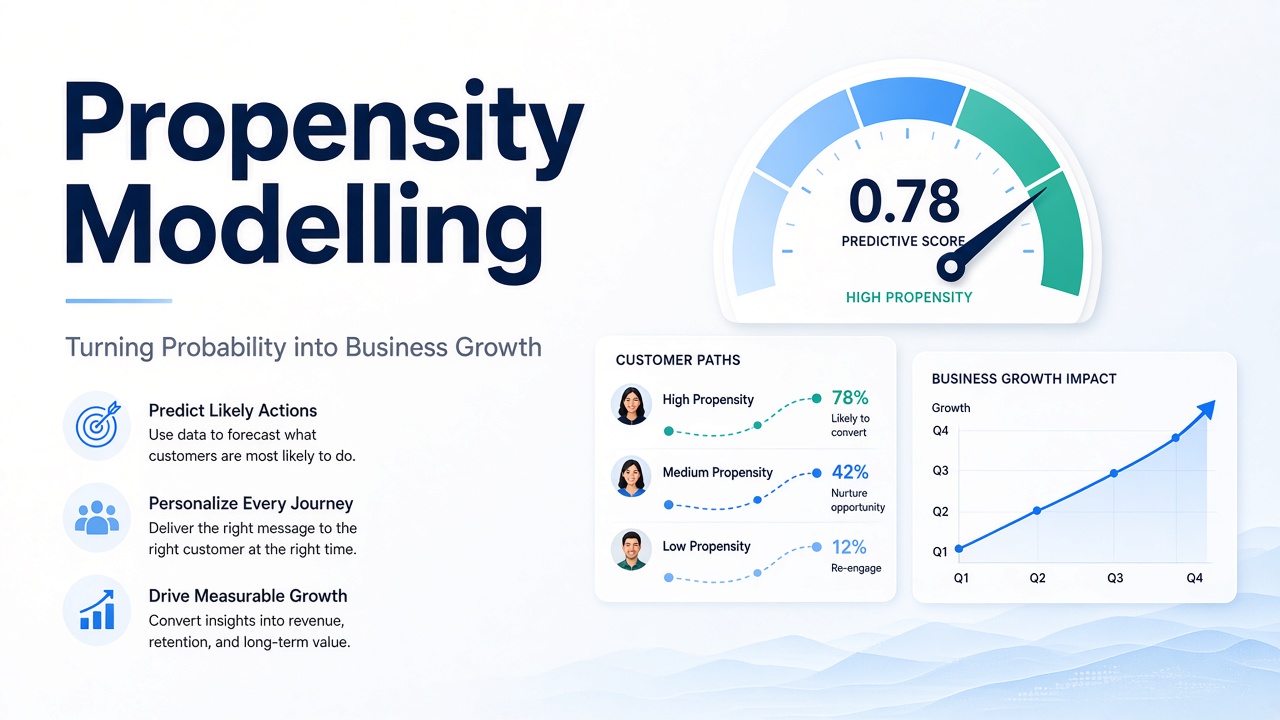
Turning probability into business growth
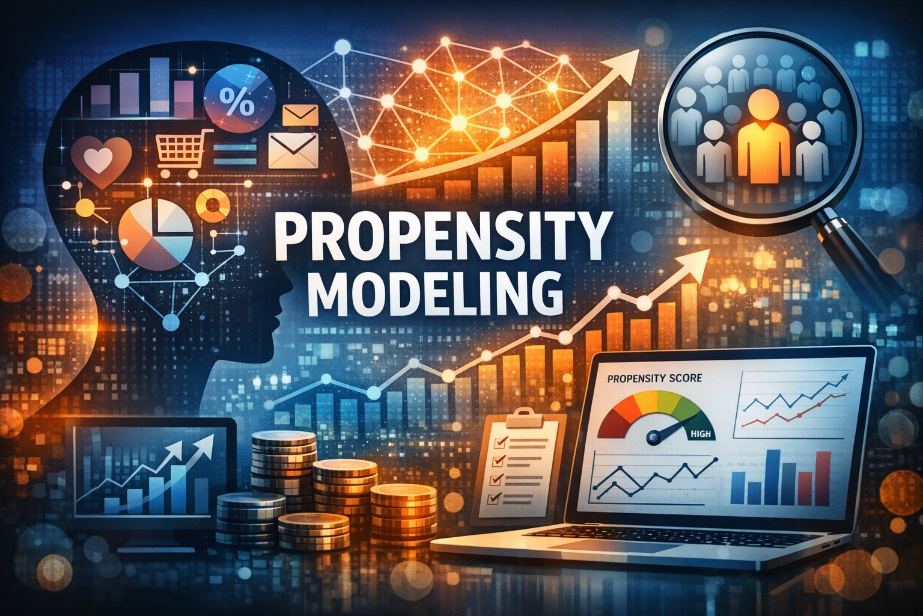
In modern data-driven organizations, knowing what happened is no longer enough. Businesses need to know what is likely to happen next—and more importantly, what actions to take today. This is where propensity modelling becomes a critical pillar of advanced analytics and marketing intelligence.
Propensity modelling predicts the probability that a customer will take a specific action—such as purchasing a product, clicking an ad, churning, upgrading a plan, or responding to an offer. Unlike descriptive analytics, propensity modelling is forward-looking, enabling proactive decision-making across marketing, sales, and business operations.
Propensity modelling is a predictive analytics technique that assigns a propensity score—a probability value between 0 and 1—to each customer or entity. This score represents how likely they are to perform a specific action.
Examples of common propensity use cases:
In simple terms: Propensity modelling ranks customers by likelihood of action, helping businesses prioritize where to spend money and effort.
Traditional targeting relies on demographics, interests, and past behaviors. Propensity modelling goes further by predicting future behavior. Instead of targeting broad segments, marketers can target high-propensity users who are most likely to convert.
Propensity scores enable dynamic personalization across channels. For example:
This moves marketing from generic messaging to individual-level decisioning.
Marketing budgets are finite. Propensity modelling ensures budgets are allocated to users and channels that drive incremental impact, not just reach. Instead of bidding equally on all users, brands can bid higher for high-propensity segments and reduce spend on low-propensity ones—maximizing ROAS.
Propensity modelling is not just a marketing tool—it is a business optimization engine.
Machine learning algorithms like logistic regression, random forest, gradient boosting, or neural networks predict probabilities.
Each customer receives a propensity score, which is then used in campaign targeting, personalization engines, CRM workflows, and media bidding strategies.
From a business and marketing lens, success is measured not just by model accuracy but by business impact.
Anonymous customer targeting: Website visitors who never complete a lead form are often where most retargeting budget is wasted. GA4’s BigQuery ML-based propensity model helps here.
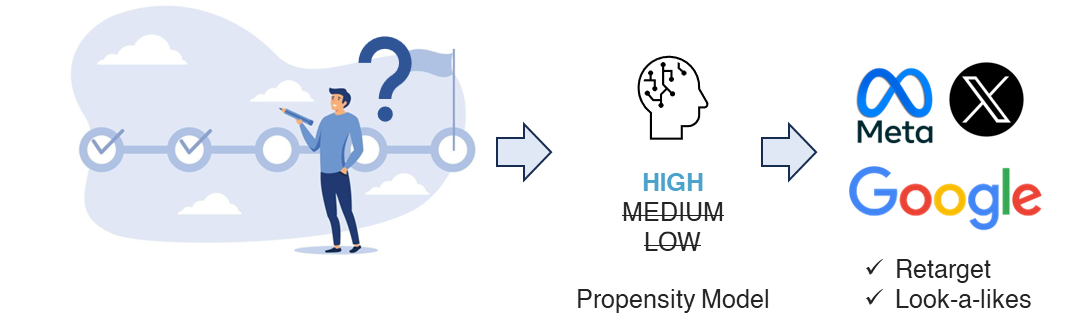

For lead form fillers: Creating a customer single view for users who have filled a lead form unlocks behavioural and attribute-level signals for propensity audiences that can be retargeted on Google and Meta.
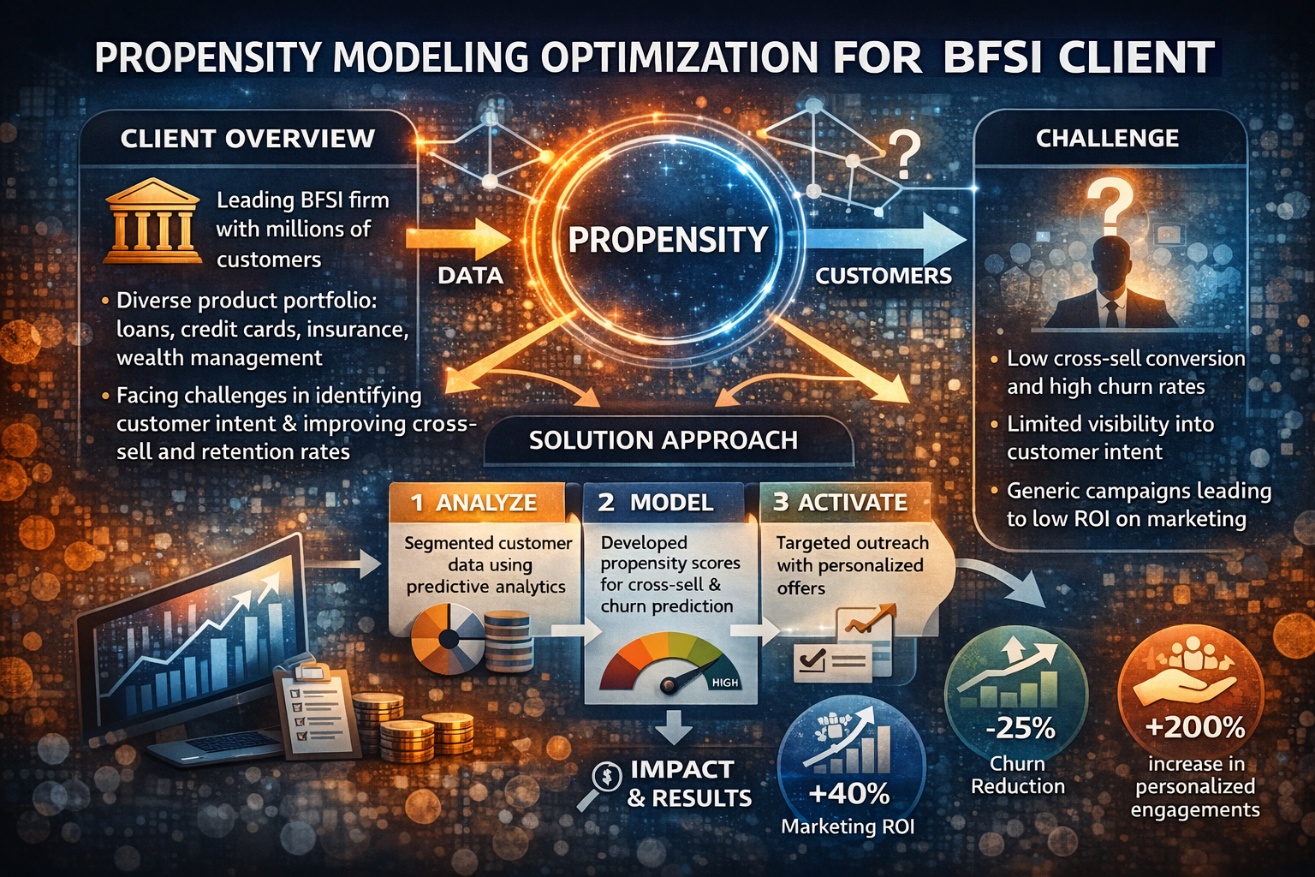
The real differentiation is not the algorithm—it is the activation maturity.
Propensity modelling is evolving into real-time decision intelligence with streaming data pipelines, AI-driven personalization engines, integration with MMM and budget optimization frameworks, and privacy-first modelling using aggregated and first-party data.
In the future, propensity scores will dynamically guide media bidding, content personalization, pricing strategies, and product recommendations.
Propensity modelling shifts organizations from reactive reporting to predictive, proactive growth. It enables marketers to target smarter, businesses to operate efficiently, and leadership to make data-backed decisions that directly impact revenue and profitability.
In a world where every marketing rupee and business decision must be justified, propensity modelling is no longer optional—it is a strategic necessity.
Talk to DataQuark about building and activating propensity models—from Customer 360 and scoring to campaign and media activation.
Talk to usWhat would you love to learn how to do?