 Loading Please Wait...Loading Please Wait...
Right now, somewhere, a marketing manager is toggling between five browser tabs trying to answer a question that should take five minutes: how did we actually do last week?
Google Analytics for traffic. Ads Manager for spend. The CRM for leads. And a spreadsheet — someone built it a while back, nobody remembers exactly who — that’s supposed to tie it all together. Two hours later, there’s a number. It’s probably close to right. Nobody’s fully sure.
If that sounds familiar, you don’t have a reporting problem. You have a data infrastructure problem. And it has a name: Marketing Data Infrastructure, or MDI.
MDI is the system that connects all your marketing data — ad platforms, website analytics, CRM, email, e-commerce — into one place where it’s clean, consistent, and ready to use.
The easiest way to think about it: plumbing. Nobody admires good plumbing. You only notice it when it’s missing — when the tap sputters, or worse, when what comes out isn’t quite clean. MDI is the plumbing behind your marketing numbers. Get it right, and dashboards just work. Get it wrong, and every report becomes a small investigation.
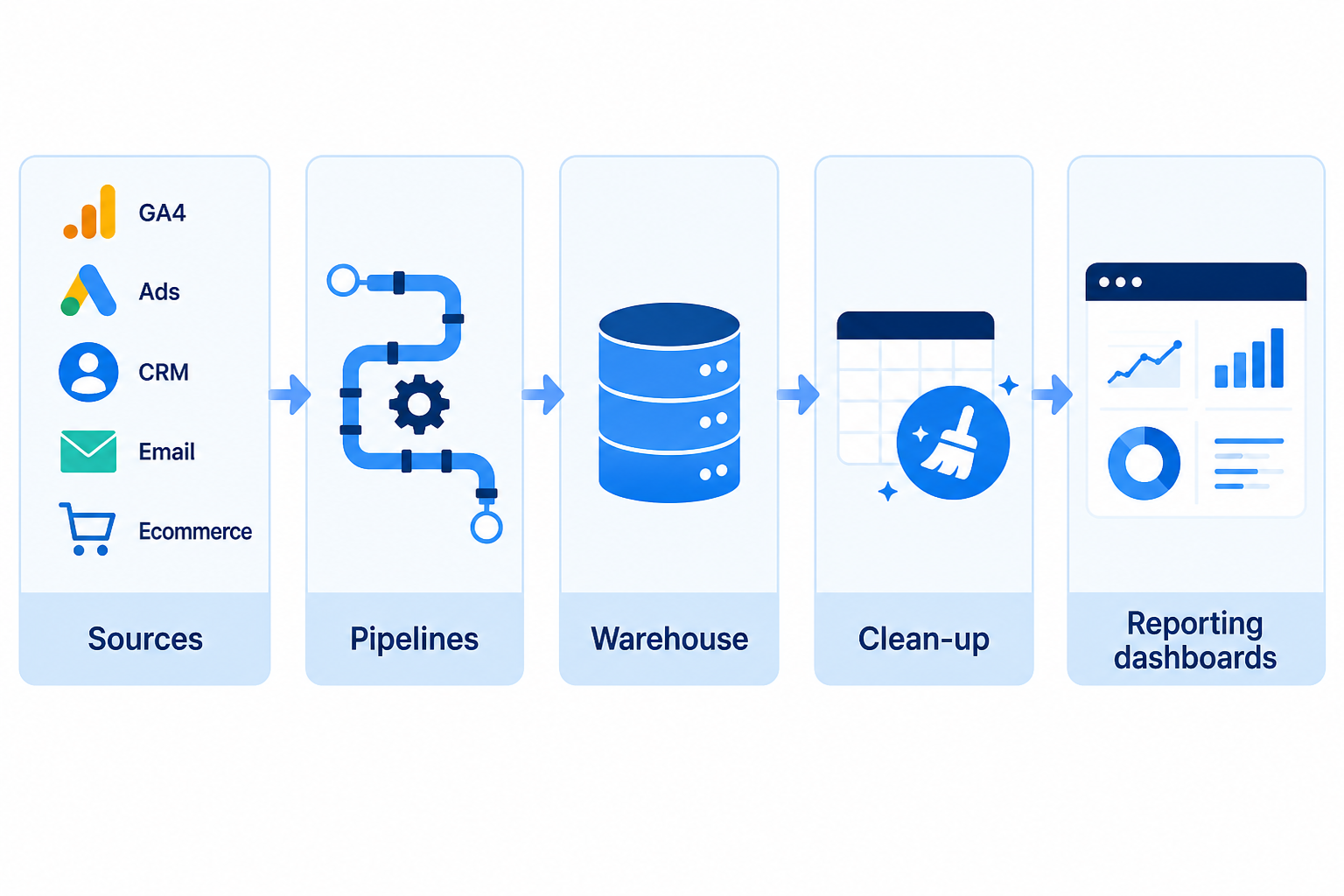
It’s not one tool. It’s a few things working together:
Here’s roughly what that flow looks like once it’s running:
If it feels like your team is uniquely bad at this, it isn’t. Gartner’s own research on marketing technology found that teams now use only about a third of the tools they’ve already paid for — down from well over half just a few years ago — largely because none of it is wired together properly. Most businesses aren’t short on data or tools. They’re short on plumbing that connects the two.
We worked with a skincare brand a while back — mid-size, spending across Meta, Google, and Amazon Ads, with Shopify running the store. Every month, someone on their team spent close to three days just pulling numbers into a master sheet before the actual analysis could even start.
The bigger issue wasn’t the time. It was that Meta’s “conversions” and Shopify’s “orders” never quite matched, and nobody could say with confidence why. So budget decisions kept leaning on whichever platform’s dashboard looked best that week — not the one actually driving results.
That’s not a rare story. It’s the default state for most growing businesses, right up until someone fixes the plumbing.
None of this shows up as a dramatic failure. It’s slower than that.
Each of these is small on its own. Add them up over a year, and it’s a real cost — just one that never shows up as a single line item, so it’s easy to keep ignoring.
If two of these feel familiar, this isn’t really a “someday” problem anymore.
A lot of teams assume MDI just means “buy a nicer dashboard tool.” It doesn’t. A dashboard is only as trustworthy as what’s feeding it — if the pipeline underneath is still manual and messy, a prettier chart won’t fix that. It just puts a nicer window on the same cluttered room.
The real work happens before the dashboard: in how the data is pulled, connected, and cleaned.
No — smaller teams often feel it more, since they don’t have spare hands to patch data together manually every week.
No. Most businesses set this up with a specialist partner instead of hiring for it.
Usually a few weeks, depending on how many data sources are involved.
No. It connects them — GA4, your CRM, your ad platforms all stay exactly as they are.
Marketing Data Infrastructure isn’t the kind of thing that makes it into a campaign case study. But it’s usually the real difference between decisions made on solid ground and decisions made on numbers nobody’s quite sure about.
If any part of this sounded like your Monday morning — mismatched numbers, hours lost stitching reports, decisions based on whichever dashboard looks best that week — you’re far from alone. It’s one of the most common problems we come across.
Reach out to us — at DataQuark, we’ve worked with plenty of teams who knew they needed to sort out their marketing data, but weren’t sure where to even begin.
Talk to usSource: Gartner Marketing Technology Survey, via MarTech.org
What would you love to learn how to do?