 Loading Please Wait...Loading Please Wait...
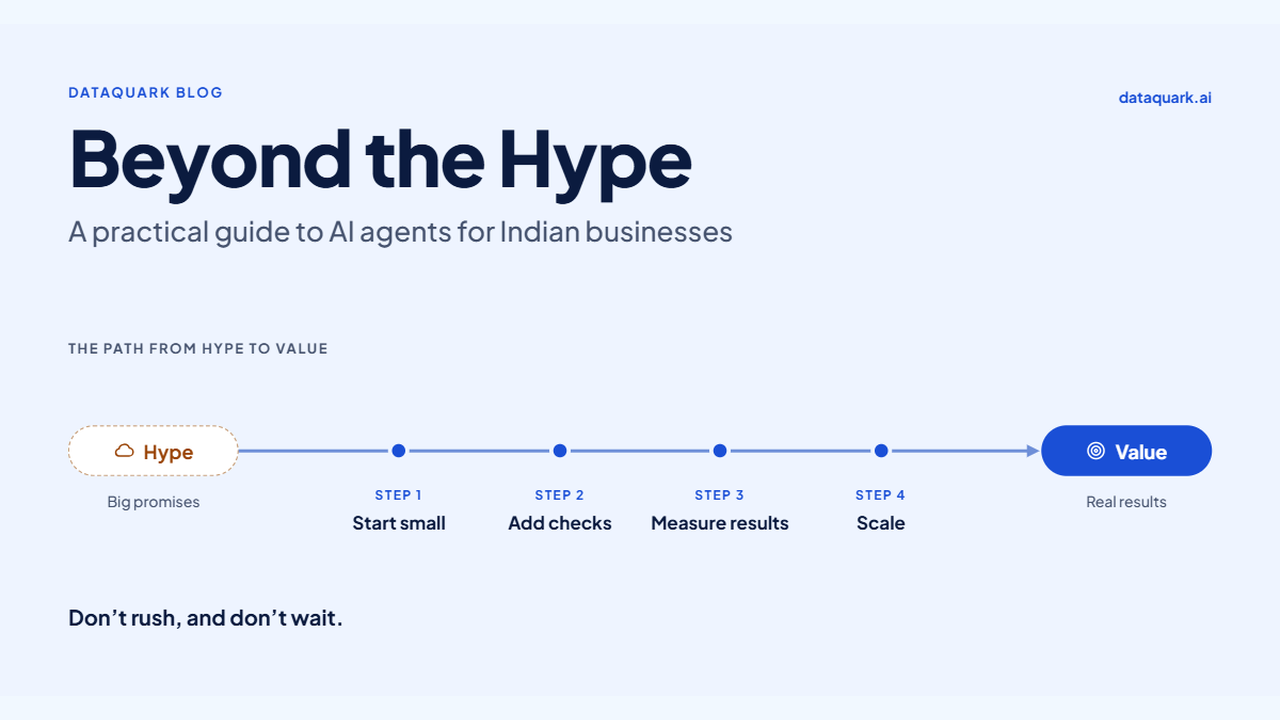
What's working, what to watch out for, and how to move forward at your own pace.
AI agents are everywhere this year. Every software platform has one, every conference talks about them, and most leadership teams are hearing the same question: "What's our AI agent plan?"
Before answering, it helps to ask a few quieter questions:
This guide covers where AI agents stand, where they struggle, and how Indian businesses can use them safely and profitably.
A regular AI tool answers questions. An AI agent takes action: it reads information, makes decisions and completes tasks across your systems.
Instead of just drafting a reply to a customer, an agent could find their record in your CRM, write the response and send it. That's powerful. It also means its mistakes have real consequences.
The progress is real, and top models now score very high on popular tests. But scores drop sharply on fresh work the models haven't seen before. So when a vendor quotes an impressive score, ask: tested on what?
This is the most important idea in this guide.
Imagine an agent that gets each step right 90% of the time. Now give it a 20-step task, like taking a new lead from a form into the CRM and on to a follow-up email. The chance it gets every step right is only about 12%.
Even at 95% per step, a 30-step process succeeds only about 21% of the time.
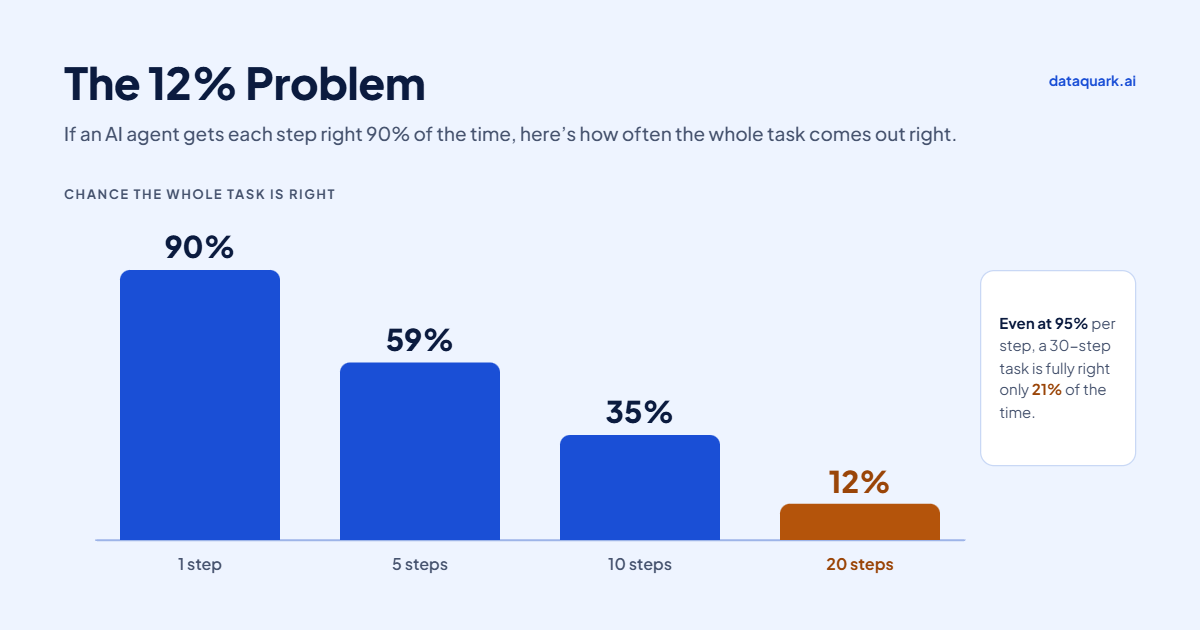
High accuracy on one step doesn't mean the whole job is done right. The longer the process, the more checks you need along the way.
How many steps do your most important processes have?
Getting started is easy. Getting value needs clean data, clear goals and the right checks.
Is your team measuring results, or counting launches?
👉 Want to know if your data is ready for AI? Talk to us
Big tech companies are spending hundreds of billions on AI, and that money needs a return. "Your competitors are already doing this" adds more pressure. And Gartner estimates that only about 130 of the thousands of vendors selling "AI agents" offer the real thing. Many are rebranded chatbots.
The opportunity is still real. Gartner expects at least 15% of day-to-day work decisions to be made by AI agents by 2028. The point isn't to avoid agents. It's to adopt them with a clear head.
Build deeply on one AI provider and switching gets hard. Your prompts, tool connections, document search, monitoring and team skills all become tied to that one platform.
AI models improve every few months. If a better or cheaper one arrives next quarter, could you switch?
AI shines at understanding messy language and handling new situations. Simple rules win at calculations and fixed steps, because they're faster, cheaper, more predictable and easier to explain to auditors.
The best agents mix both. A customer service agent might use AI to understand the request, simple logic to route it, a rules check to confirm it follows policy, and a direct system action to resolve it.
Agents bring new risks:
India's DPDP rules add another layer. Most duties take effect on 13 May 2027, and any agent that touches customer data (CRM, leads, support tickets, marketing lists) falls under them. We explored this in The Consent Gap.
Every agent needs the basics: only the access it truly needs, its own identity like an employee, checks on what goes in and out, and a record of every action.
Document processing, support ticket sorting, code review with human sign-off, research summaries, and marketing operations like monitoring campaign health.
What these have in common: mistakes are caught quickly, they're easy to fix, and a person checks the work.
Waiting until 2028 means cheaper AI, but also a skills gap, competitors ahead and a rush to comply. Acting now, carefully, means your team learns early through small, supervised projects.
Start small, build the right foundation and grow with confidence.
DataQuark, the data and AI unit of LS Digital, helps businesses move from AI experiments to real results:
Start with a clear view of readiness, risk and where agents can actually add value.
Talk to usSources: McKinsey, The State of AI (2026); Gartner (2025); MIT (2025); Cisco, State of AI Security (2026); OWASP; DPDP Rules 2025 (MeitY).
What would you love to learn how to do?