 Loading Please Wait...Loading Please Wait...
Imagine a customer emails you one morning:
"Please delete all my personal data from your systems."
Simple enough. But think about where that request has to travel: your website, your CRM, Meta and Google, your email tool, maybe a spreadsheet someone downloaded last year.
How many of those places would your team remember to check?
If the honest answer is "we'd need to find out," you're in good company. Most brands are in the same spot, and there's still time to fix it.
Curious where you stand? Book a free DPDP Marketing Readiness Check
Over the past year, most companies have done the sensible first thing for India's DPDP rules: they updated their privacy policy.
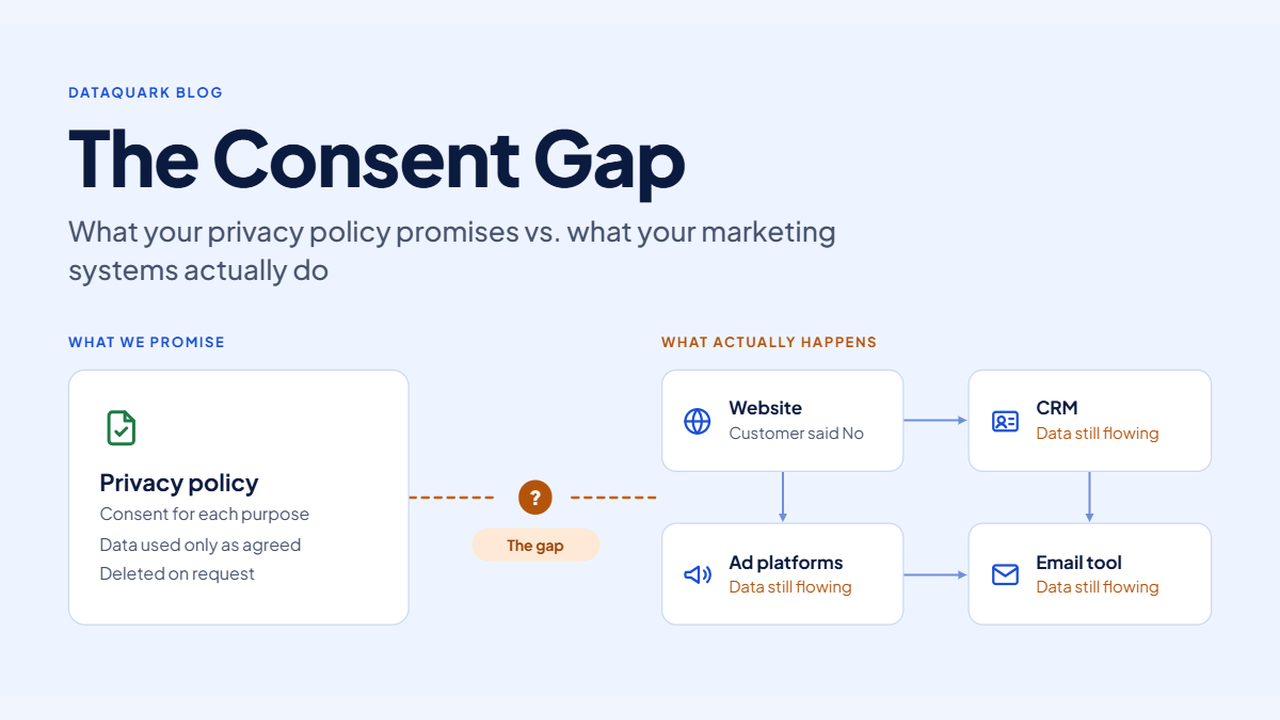
But a policy only describes what should happen. Your marketing systems decide what actually happens.
The distance between the two is what we call the Consent Gap.
Timing matters too. Most DPDP compliance duties take effect on 13 May 2027, and the government has discussed bringing some deadlines forward.
So the real question isn't "Is our policy updated?" It's this: do our systems keep the promises our policy makes?
Marketing stacks grow one tool at a time. A pixel for a new campaign. A CRM integration for sales. A new form, a chatbot, another analytics setup.
Each one made sense when it was added. But nobody designed them to work together around consent. So data flows in many directions, while consent decisions often stay behind on the website.
Does anyone in your team have the full picture of where customer data goes today?
Instead of a long compliance checklist, think of consent as four moments. Each one is a place where the gap can open up.
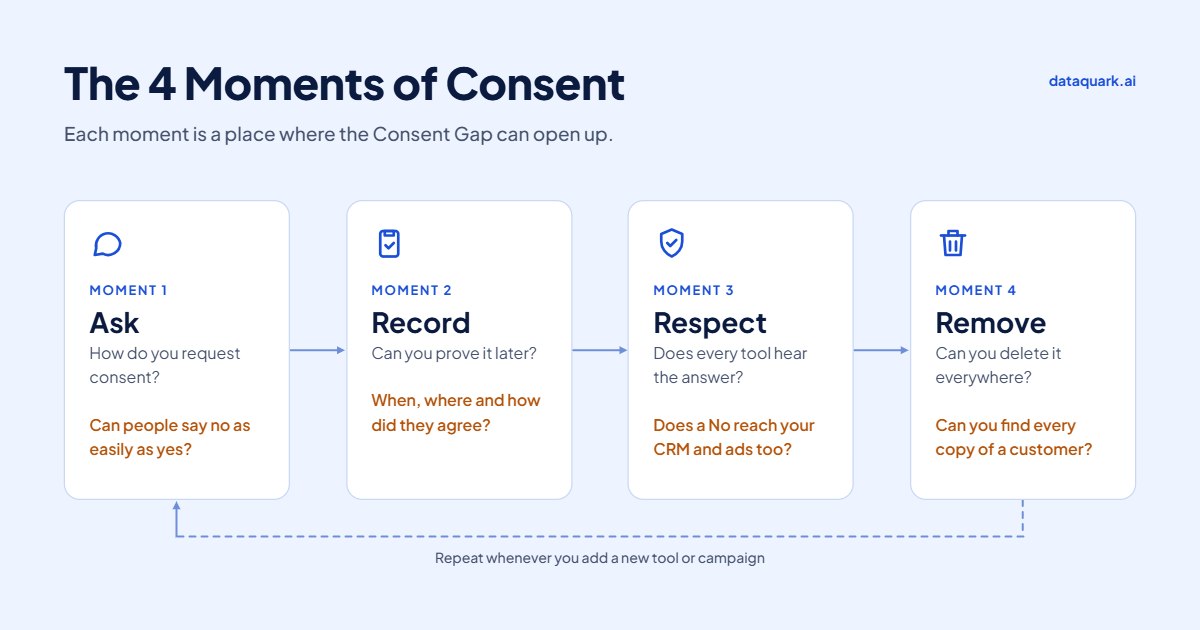
Consent should be clear, specific to each purpose and easy to refuse. Saying no should be as simple as saying yes.
Does your banner offer real choices, or one big "Accept All" button?
A "yes" only helps if you can show when, where and how it was given.
Could you find that record for a lead from six months ago?
A customer may say no on your website, but their data can still flow to your CRM, ad platforms or other connected tools. We explored why in The Pixel Problem.
It's also about how data is shared. In the CRM-to-ad-platform data flows we build for BFSI, fintech and D2C brands, customer details are scrambled one way before they leave the brand's systems. Ad platforms get the signal they need, without seeing raw personal data.
When a customer says no, does every system that receives their data respect it?
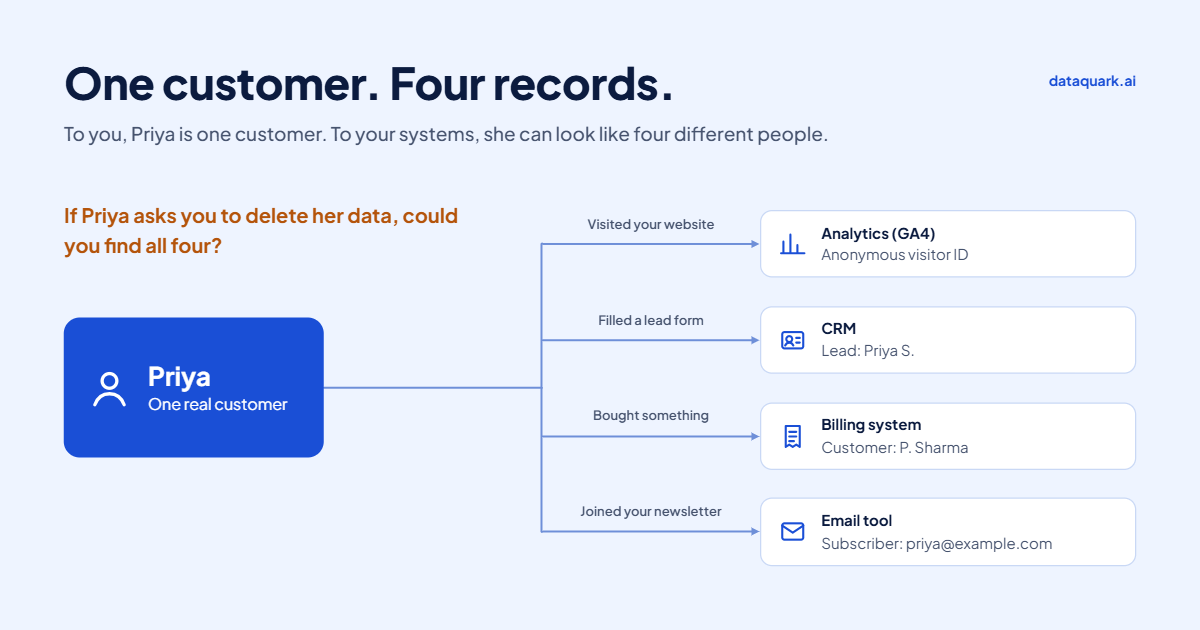
Imagine a customer named Priya. She first visits your website. Later, she fills a lead form. Then she buys something. She also signs up for your newsletter.
To you, she's one customer. In your systems, she might be saved as four different people: in GA4, your CRM, your billing system and your email tool.
If Priya asks you to delete her data, how easily could you find all four?
And what about older lead lists and loyalty data collected years ago? Do you know why you're still keeping them?
Give yourself 1 point for every "Yes":
Ask
Record
Respect
Remove
Your score:
Tip: look at which moment lost you the most points. That's where to start.
Want help reading your score? Get a free readiness check.
For most teams, it comes down to a few building blocks:
Every customer who says "yes" gives you data you can trust. When consent is clear and easy, your data is cleaner, your reports are more reliable, and your ad platforms learn from accurate signals.
We've seen this first-hand. Across 10 brands using our CRM-to-ad-platform integration, campaign performance improved by up to 10% after implementation.
So beyond "How do we comply?", ask a better question: how do we earn more yeses?
Does DPDP apply to my business? If you collect customer data online in India, it's worth checking. Our readiness check can help.
Is Google Consent Mode V2 enough? It helps with Google tools, but it doesn't cover your CRM, other ad platforms or data storage. More in our Consent Mode V2 blog.
Remember the customer who asked you to delete their data? Once the gap is closed, that request becomes a routine task rather than a last-minute rush.
DataQuark helps marketing teams close the Consent Gap while keeping campaigns running smoothly.
30 minutes. No obligation. A clear view of where your gap is.
Book a readiness checkWhat would you love to learn how to do?