 Loading Please Wait...Loading Please Wait...
Every marketing team has a few unwritten rules. Which report to ignore on a Monday. Which CRM field nobody trusts. Which number to check twice before it reaches the leadership meeting. None of it is written down. People just know.
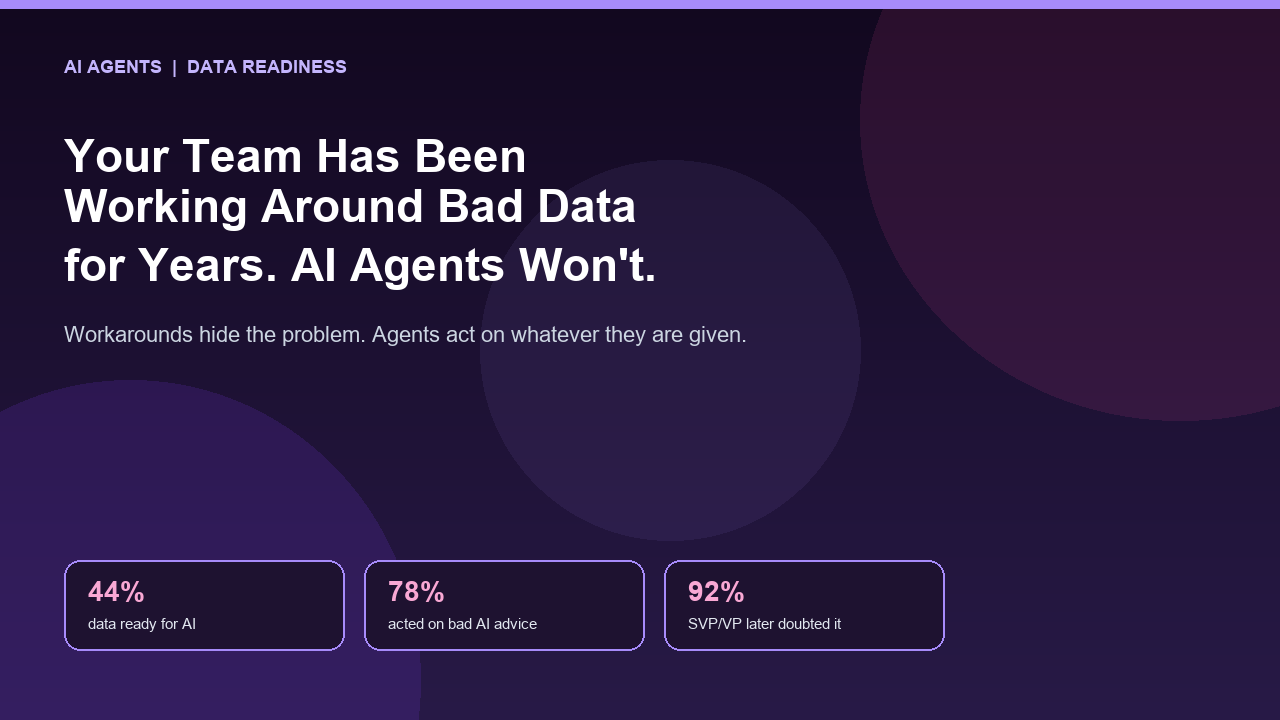
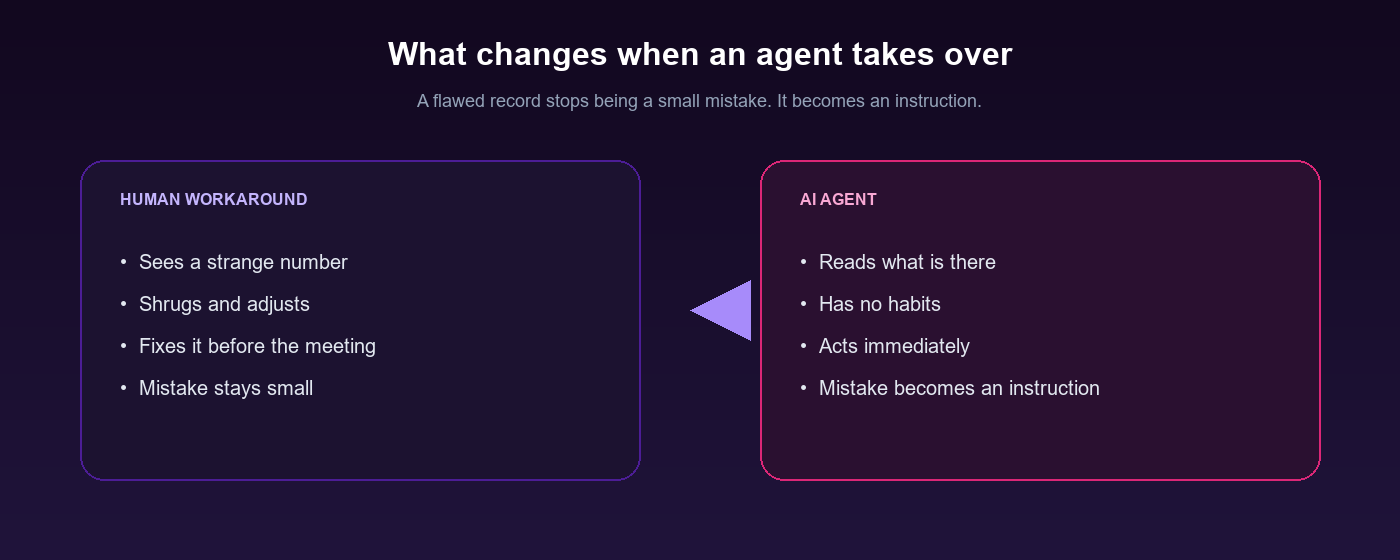
That quiet knowledge is why bad data has not hurt more than it has. A person sees a strange number, shrugs and adjusts. An AI agent does not shrug. It acts on whatever it is given.
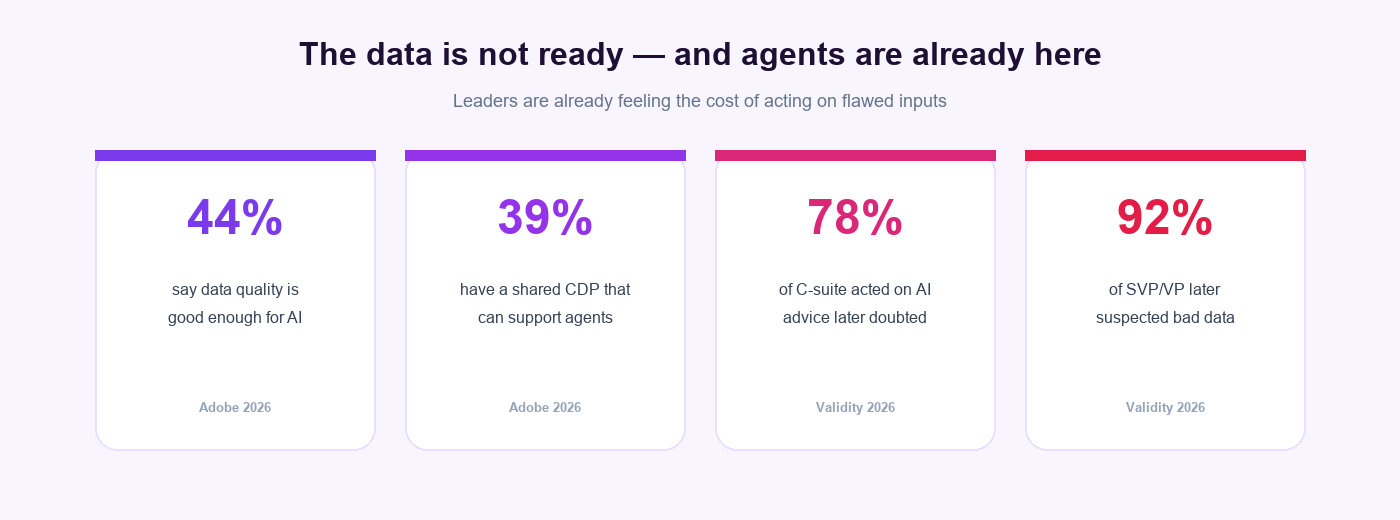
Adobe's 2026 AI and Digital Trends report surveyed 3,000 executives and practitioners. Only 44% said their data quality and access is good enough for AI. Only 39% have a shared customer data platform that can support agents.
Leaders are already feeling the effect. In Validity's 2026 CRM data survey, 78% of C-suite respondents said they had acted on an AI recommendation they later suspected was wrong because of bad data. Among SVPs and VPs, it was 92%.
Gartner found something similar. Of the martech leaders running agents in pilot or production, 45% said vendor-offered agents were not delivering the results they were promised.
When data cannot be trusted, teams build habits around it. Nobody calls these habits a problem, because the work still gets done.
We saw this with one of India's largest life insurers. It split its marketing budget across channels mostly out of habit, because it had no proof of which channel actually drove sales. Once its online and offline customer data was brought together, it could see what really worked, and it saved a meaningful share of its campaign budget.
The habit was not the fault. It was a sensible response to data nobody could rely on. But it kept the real problem out of sight for years. When nothing visibly breaks, nobody asks why the numbers needed so much care in the first place, and the cost of that care never shows up on any report.
An agent has no habits. It does not know that a field is unreliable or that a report is usually wrong on Mondays. It reads what is there and acts, often faster than anyone can check.
So a flawed record stops being a small mistake that someone catches in a meeting. It becomes an instruction.
We learned this ourselves. DQ Nexus is the tool we built with our SEO team to compare our website content against competitors. Before it, the work was manual. Analysts read competitor sites by hand, each in their own way, so quality changed from person to person. Findings ended up spread across different documents, and a single analysis took days.
DQ Nexus now does it in about 20 minutes. But it only worked once we agreed, in writing, what every analysis must look at: brand knowledge, content gaps, entities, keywords and prompts, and blog drafts. Those are the five things it checks every time.
We did not need cleaner data to start. We needed to write down what our analysts were already doing in their heads. The agent could not copy a habit. It could only follow a rule.
Before you give any task to an agent, find out what your people quietly do today. Three questions help:
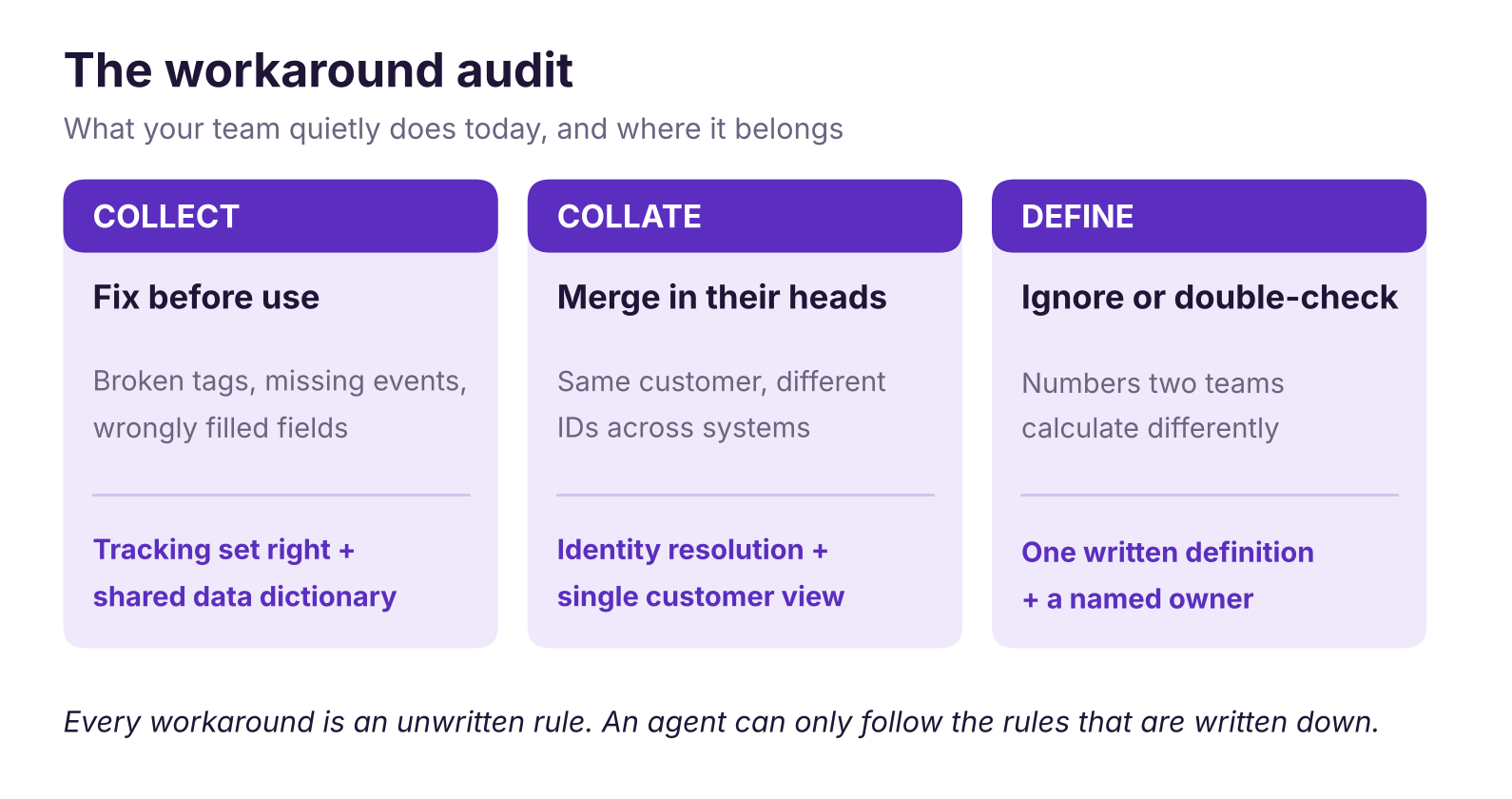
Broken tags, missing events, wrongly filled fields. This is a Collect problem. Tracking should be right, and a data dictionary should say what each field means.
Two records that are clearly the same customer, or one person with different IDs in different systems. This is a Collate problem. The answer is identity resolution and a single customer view, like a Golden Record.
Numbers that two teams define differently. This is a definitions problem. Write the definition down and give it an owner.
Every workaround you find is an unwritten rule. An agent can only follow the rules that are written down.
You do not need a big project. Sit with the two or three people who prepare your regular reports and ask one plain question: "What do you do to this data before you trust it?"
The list will probably be longer than you expect. That is the point. It shows how much your team has been quietly carrying, and how much an agent would have got wrong without being told.
This is also why agents belong at the Activate stage, after Collect and Collate are in place. We explain the full stack in The 7-Layer Stack Behind Autonomous Agentic Marketing.
Not sure how many of your team's workarounds are written down anywhere? It is worth finding out before an agent does. If you want a second pair of eyes, talk to our data team.
Talk to our data team before you hand a process to an agent.
Talk to usWhat would you love to learn how to do?