 Loading Please Wait...Loading Please Wait...
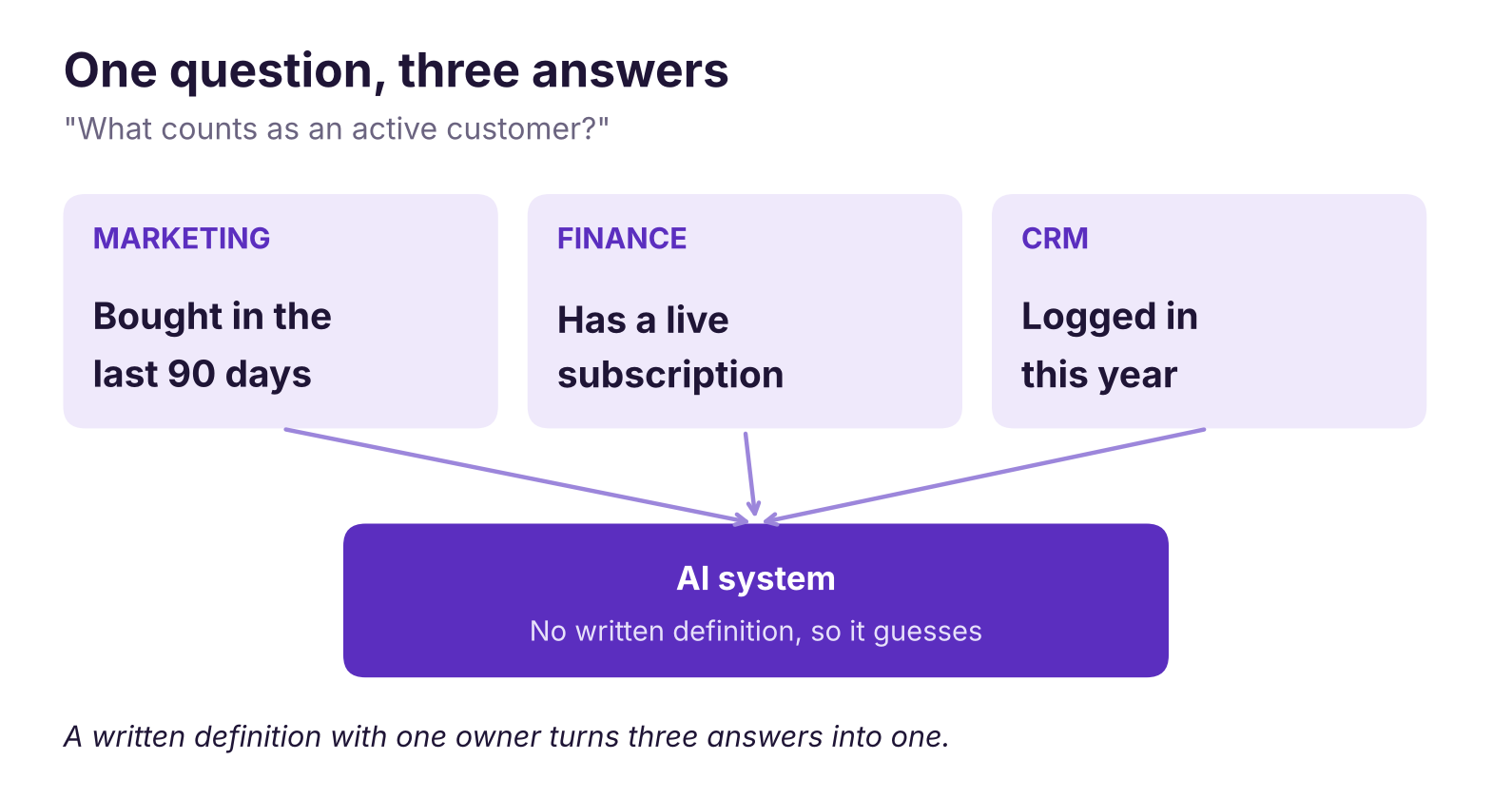
Picture a new analyst on her first week. She opens a dashboard and asks a simple question: "What counts as an active customer?"
The marketing lead says anyone who bought in the last 90 days. The finance lead says anyone with a live subscription. The CRM team says anyone who logged in this year. All three are confident. All three are right, in their own system.
Nobody wrote the answer down. So the analyst does what every new joiner does. She picks one, adds a footnote, and moves on.
That small moment is where many AI projects quietly begin to go wrong.
People can work with unclear data. They ask a colleague, remember how a number was calculated last quarter, or just sense that a figure looks off.
An AI system has none of that. It only knows what the data and its documentation tell it. If "active customer" means three things, it will either pick one at random or mix them together. Either way, it will sound sure of itself.
This is why the least exciting file in your company matters so much. It is called a data dictionary, or data documentation. It is simply a written record of what each piece of data means, where it comes from, how it is calculated and who is responsible for it.
For AI, that record works like a set of instructions. Without it, you are asking the system to guess.
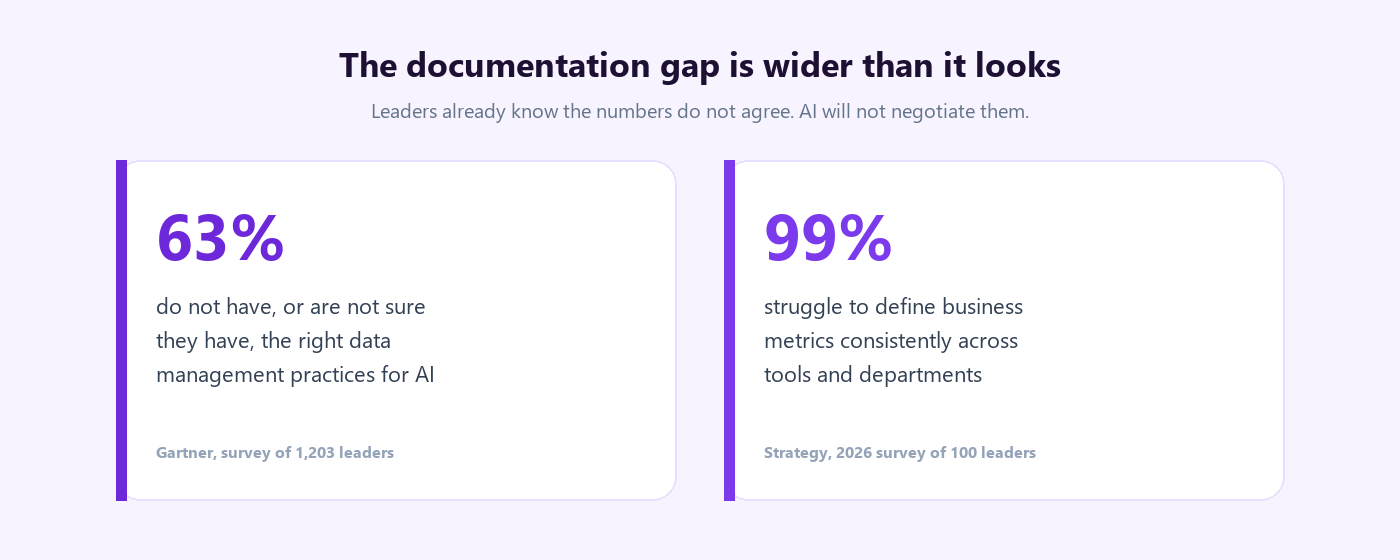
Gartner surveyed 1,203 data management leaders and found that 63% either do not have, or are not sure they have, the right data management practices for AI. Gartner also notes that many organizations lack the metadata they would need to judge whether their data is ready for AI at all.
The problem shows up in the basics too. A 2026 survey of 100 enterprise leaders by Strategy found that 99% struggle to define business metrics consistently across tools and departments. It is a small survey, but the pattern will be familiar to anyone who has sat in a meeting where two teams brought two different numbers for the same thing.
If this document is so useful, why does it not exist in most companies? Usually for three plain reasons:
No one is rewarded for writing it, so it never reaches the top of anyone's list.
It is not exciting, and the benefit only appears much later, so it is easy to put off.
The person who knows how a number is built leaves, and the logic leaves with them.
None of this is carelessness. It is just that the cost of not having the document is spread across many small moments, so no single moment feels worth fixing.
You may already see these signs:
Each one looks like a separate problem. They usually share one cause: the meaning of the data lives in people's heads. That works while the same few people stay and nothing new is added. It stops working the day a team grows, someone leaves, or you ask an AI system to do the checking those people used to do.
You do not need to document everything. A small start is enough, and it is more useful than an ambitious plan that never finishes.
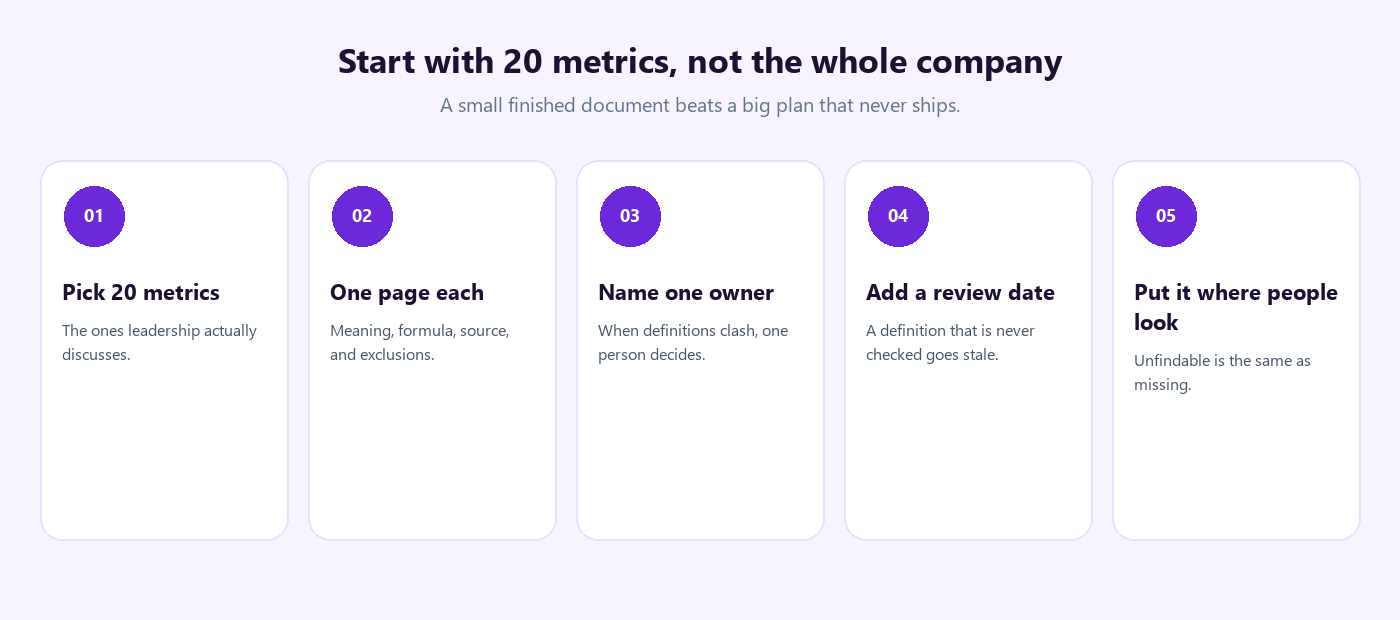
Once those 20 are done, you will already have fewer arguments about numbers. You will also have something an AI system can actually rely on.
At DataQuark, we think of this as part of the Collect stage. Before data is joined together or put to work, it has to be tracked properly and described clearly. Our Data Documentation and Tag and Data Dictionary work is built around exactly that: writing down what the data means, so that people and AI systems read it the same way. You can see how the stages build on each other in The 7-Layer Stack Behind Autonomous Agentic Marketing.
If a new analyst asked your team what "active customer" means, how many different answers would she get? It is a quick test, and a good place to start. If you want help turning the answers into one clear definition, talk to our data team.
Talk to our data team about documenting the metrics that actually get used.
Talk to usWhat would you love to learn how to do?